Prairie Outdoors
  • Email
  • Facebook
  • RSS
  • Home
  • Outdoors Blog
  • Campgrounds and Camping
    • Alberta Campgrounds
    • Saskatchewan Campgrounds
    • Manitoba Campgrounds
    • Camping Photo Contest
    • Country Building Photo Contest
    • Boats and Trailers
    • ATV and Snowmobile Rentals
    • Campground Reservations
  • Hunting
    • Wildlife on Camera 2026
    • Hunting Photo Contest
    • Outfitter Guides and Lodges
    • Buy Hunting Licenses
    • The Campfire
    • Our Favorite Places
    • Know Your Species
    • Saskatchewan Whitetail and Mule Deer Seasons
    • Deer Antler Scoring Whitetail and Mule Deer
    • Scoring Your Black Bear Trophy Skull
    • Moose Antler Trophy Scoring
    • Hunting Dogs
  • Fishing
    • Fishing Photo Contest
    • Buy Fishing Licenses
    • Fishing Camps and Lodges
    • The Campfire
    • Our Favorite Places
    • Ice Fishing
    • Pike & Walleye Weight Chart
  • Outfitters
    • SK Deer Hunting
    • SK Moose Hunting
    • SK Bear Hunting
    • SK Goose Hunting
    • Alberta Outfitters and Guides
    • Saskatchewan Outfitters and Guides
    • Manitoba Outfitters and Guides
    • Trip Finder
  • Hunts For Sale
  • Games
    • Outdoor Hangman
    • Outdoor Trivia
    • Outdoors Trivia 2
    • Survey – Broder Buck vs Hanson Buck
    • Survey – Fishing – Keep or Release
    • Survey – Fishing – Lefty or Righty
    • Survey – Shotgun for Geese
    • Survey – Fishing – Pike vs Walleye
    • Survey – Fly Fishing vs Spincasting
    • Survey – Upland Birds vs Waterfowl Hunting
  • Advertise
    • Advertise Your Outfitter Business
    • Advertise Your Campground
    • Outdoors Web Site Development
    • Sponsor Opportunities on Prairie Outdoors
    • Advertise Your RV Dealership
  • About
Search the site...
  • Home
  • Outdoors (Page 3)

Hunting is Like Hitting a Baseball

May 10, 2026 / galen / Hunting, Outdoors

I love hunting. I love baseball. Let me take you on a bit of a stretch comparison as I parallel the two activities.

Practice

It should go without saying, that to be a good hunter, to be a good hitter, you need to practice shooting, to practice swinging. Practice comes in many forms, many drills, many situations. You need to practice until your routine, your movements are instinctive.

Patience, Patience, Patience

I get to spend a lot of time hanging out with hunting outfitters, and I used be a hunting guide, so I have heard many many times the how the virtue of patience will payoff for hunters. When big game hunting, you need to spend the time in the seat to wait for the right animal. Most likely, that will not be the first Bear, or Deer, or Elk, or Moose that you see. If you have been using trail cameras, or if you have been pre-hunt spotting the area, you know the potential. Patience will reward you. For a waterfowl hunter, the idea of patience comes in the form of letting the birds work to the decoys. If you pull up at 50 yards when birds are still on approach, you may only shoot the clouds. Let the birds work over the decoys and drop their feet.

As a hitter, patience is often describe as “getting a good pitch to hit”. If you are sitting on a fastball, don’t swing at the curveball. If you are looking for an off-speed pitch, let the fastball go. Some hitters look for any pitch in the location they want. Some look for a specific pitch. Both approaches will work, if you add patience to the approach.

Wait for the Right Moment

The “Moment of Truth”, it’s that time when the factors fall into place. The right animal, in your range, giving you a great shooting opportunity. Make sure your moment includes a shot you can make, in range of you and your weapon. If the moment is not right, stay off the trigger. I’ve heard the right moment described as that time when it feels like your heart is trying to jump out of your chest. Take an extra bit of time to calm down, before the trigger pull. The situation is somewhat different in waterfowl hunting. If the moment is right, act quickly.

In baseball, this is somewhat the same reaction as in waterfowl hunting. When patience has rewarded you with a good pitch to hit, time to get extremely aggressive. This is when your instincts take over to deliver the bat to the ball. Timing and bat head accuracy, the results of practice, take over.

Scouting

Preparation should take 100 times more than hunting or hitting. In hunting, choosing the location is what puts you in the best place to make your shot. Mother nature always plays a role. Changing weather and changing animal activities all can change your opportunity. The presence of a predator animal may put your hunt off for a few hours, or the whole day.

In baseball, scouting the opposing pitcher, how they pitch hitters like you, how they are pitching that game, help you understand what your best opportunity will be. Along with the pitcher tendencies, if you know the umpire tendencies, such as a high strike zone, giving an extra inch on the outside corner, etc. may help you adjust your approach. If the pitcher has a tendency to get ahead with fastballs, then tend to off-speed, choose accordingly. (I was always looking for a fastball to hit first 2 strikes).

1 Moment

Just 1 moment can make the difference in a season, or in a game. In big game hunting, you likely only have one trophy tag. Only one chance to fill your quota with the right animal. Don’t settle early for an animal of lesser quality than you know is in the area. Come the last day of the hunt, if you are looking to fill the freezer, you might become a little less selective.

In an at bat, you have 3 strikes to work with. You can waste the at bat by swinging at the wrong pitch and making an out early in the count. The patience to wait for the 1 moment will help you be more successful. But nobody bats 1.000. You are working your approach, your plan, to give you the best chance of success.

Sometimes, It Doesn’t Happen

Despite all the right steps taken, patience, scouting, practice, and more, the win may go to Mother Nature. When that animal that excites you never arrives, or never gives you the opportunity, you have to tip your hat to Mother Nature and plan for the next season. Maybe more practice, more scouting, or the timing just work out for your next hunt.

In hitting, more often than not, your plate appearance results in you returning to the dugout. Some days, that’s the way the entire game goes. Other games, your approach pays off.

Beyond the Purchase – Some Other Costs of Snowmobile Ownership

March 3, 2026 / galen / Life at the Cabin, Outdoors, Snowmobiling

The Cost of Snowmobile Ownership. It’s well beyond the purchase price or finance payments. Like anything that moves, has an engine, and is designed for recreation, there are additional costs. Most of them quite obvious, I think, but here’s what we have encountered.

Clothing & accessories. We were fortunate to already have a good supply of winter wear, ski pants, warm gloves, boots, etc. and 2 helmets we bought for quadding. I do dome ice fishing so I have a good idea what clothes are needed for a Saskatchewan winter. The only thing that we really were missing was goggles. My old ski goggles were not in very good shape so a $40 investment and we were all geared up. We could upgrade some gear. Our snowmobile has a plug in cord for a heated visor. We could buy a couple helmets with that feature built in. My neighbour has one. Sure looks handy. $200 – $550. I do strongly encourage the use of a base layer system, what we used to call long underwear, but now it’s more technical. I have mine from hunting. They are thin, light, and make a very noticeable difference. An inexpensive set for both top and bottom can be found for $50 – $60.


Gas. The owners manual says to use 91 octane (premium).  That was $33 for a jug of gas last weekend. An extra gas can. This seems like a good idea, especially as most snowmobile riding is going to occur away from roads and further from a gas station. Running out of gas would make for a rather lengthy trek to the pumps.  A brief search lead me to a few name brand accessories including accessory brackets and gas cans for a bit over $300. As one of the reviews on the product said, “Expensive, but what accessories aren’t!”. If we get into some trail riding, we may have to dig into our wallets for these. Once we buy a second snowmobile, I think we will just carry one emergency gas can.

Maintenance / repairs.  Replacement of one of the scratchers was my first repair. I broke one in reverse. I knew to put these up before backing up, but didn’t. I found a pair at Canadian Tire on clearance for about $20. Normally these sell for $40 to $60 a pair. I learned in this case, that universal is not universal as a replacement if it doesn’t match the original. The original was  also an aftermarket accessory and they have slightly different spring hole placement locations. Just enough to need a little bit of a field fix, but we got the new one installed.


When things go wrong: spark plugs. This weekend was planned to be a weekend of riding with others. One of my sons was already out at the cabin and I joined him to do some riding. He just completed his SK Snowmobiling Safety Course so that he can ride legally. The cost of this course is only $50 and can be done online. See more at sasksnow.com/safety/. His comments about it were that is was a lot more practical than the Canadian Safe Boaters Course which has a ton of maritime regulations which are not very applicable to land-locked Saskatchewan. There was some fresh snow so we were expecting a few good rides. We fired up the snowmobile and let it warm up then I went for the first ride. The sled was very boggy, very underpowered, like it was over-choking, or some other similar problem. Just no power that I knew it had. I went for a short run and then let my son ride and I could tell something was not right. I waved him over, shut it off, restarted, and suddenly the power was back. We rode for a while, taking turns, took a break for lunch and the power problem was back. After a few shut down and restarts, it was running good again. The next day I went for a good ride, but had to go through the shut down and restart again to regain full power.

Making Tracks:

When it was at full power, it was a great ride. The next day, Saturday, was a day I had been looking forward to for a few weeks. My neighbours have sleds and he has a farm a few miles from our cabins and we were going to go riding together in the hills near his farm. I was very much planning for a great day of exploration and some fun with my neighbour / friend. His machine ran great, mine didn’t make it more than a 1/4 mile from the cabins when it started bogging down again and actually stalled. I managed to limp it back to my cabin while he carried on and went to play in the snow. After some pondering, as well as discussing the performance issues with my neighbour, we are making a guess that I have one if not two faulty spark plugs and when it is running on low power, it’s only running on one cylinder. I have searched for the symptoms of snowmobiles running on faulty spark plugs and the Internet supports the idea that changing plugs will improve performance. I had a similar low power issue with my boat last spring and fresh set of plugs brought the boat back to full power. The cost of two new spark plugs are less than $20 so as a maintenance expense, pretty minimal.

Heading out for a ride:


A young Mule Deer follows the tracks:

Registration. If you plan to access any public lands, such as lakes, ditches, trails, then registration is required. It’s quick and simple at sasksnow.com/registration/. The cost is:

  • $150 registration fee per year
  • $79 (pro-ratable) insurance premium

Transportation / trailering. We have not made the plunge to a snowmobile trailer. Although, as soon as you have a trailer, you start to think about other good uses of it. Our mid-term plans are that we will buy another snowmobile in fall along with a trailer. Then we can haul the sleds to the trails or go to poker rallies. You can buy a hotel on wheels for your snowmobiles for $45,000 down to a used flatbed snowmobile trailer for about $2500 or a bit less, as low as $1000 for a used flatbed trailer, not specifically designed for snowmobiles.

Some accessories are just not necessary. Our snowmobile came with a storage pouch mounted on the center of the handlebars. It would be a handy place to store a few small items, but there is storage just behind the seat as well. It is also in the perfect position to block the display including the speedometer and temperature gauge. It’s been removed.

5 Tips on Scouting for Geese

October 30, 2025 / galen / Goose Hunting, Hunting, Outdoors

I spent a dozen years as head guide for a waterfowl hunting camp in central Saskatchewan. As the spotter, you have sole responsibility for selecting and securing hunting permission for a field where your hunters will set up for the next shoot. During that time I learned a few things about scouting for geese. Some where learned the hard way, by setting up in a field and seeing no birds on approach and others simply from years and years of observation. In most spotting situations, if you have been actively spotting for days and weeks, you will have far greater knowledge and will be able to make a more informed decision. If you are out on a Friday night looking for a Saturday morning shoot, you will have far less knowledge and there is greater risk in the field you pick.

Geese Scouting Tip #1: Timing.

How many days have the birds been in the field? Are you spotting them in the morning or evening spotting? If you have consistently seen geese for a couple days, or at least the morning and evening of the same day, most likely those birds will return to the same field for the following morning and probably the afternoon as well. Morning are more consistent than afternoons. It is after the morning feed that a flock has a chance to pick out other fields and if birds are going to bounce from one field to another, likely that will be the afternoon. If the birds are pushing 3 or 4 days in the same field, they may have reached the limit or ate up most of the grain and will be moving fields soon.

Geese Scouting Tip #2: In-Bound Flock Sizes

Did the birds arrive in 1 flock or many smaller. If you saw the birds arriving at the field, did the flock on the ground build gradually? Ideally you will want a flock that arrives in many smaller groups. As the number of birds in the air increases, so too does the number of eyes looking down at your decoys and blinds. Too many eyes increases the chances of seeing something that sets off the alarms. Small groups arriving over time give you time to shoot and reload while other groups are still far enough away to not be scared off by the sounds of gunfire. A break between groups also gives the dogs a few moments to round up the dead birds on the ground.

Geese Scouting Tip #3: Variety

Are you hunting one species or mixed bag? Are the any ducks in the field? Simply put, more variety equals more certainty of opportunity to shoot. Snow Geese, Canada Geese, ducks, and Specklebellies may all have their own roosts and will fly at different times of the morning or afternoon. Geese will travel long distances from the roost to the feed field while ducks will typically feed closer to the roost so having a good number of ducks in the field increases your chances even if the geese do not cooperate. If there are Snows and dark geese in the field, and one of those species skips your field, you still have chances of a good hunt.

Geese Scouting Tip #4: Location of the Roost

How far away is the roost they came from? If the roost is very close, within one field, sometimes two, then the sounds of gunfire may be close enough to bust the roost and send the geese in another direction. If the wind direction is carrying the sounds of the shotguns away from the roost, then proximity is less and less an issue with the increase in wind speed. If you trace the birds back to a roost a long distance away, and the weather remains consistent between spotting and your next hunt, then that’s a positive. But there is a significant change in weather, such as a large increase in wind or a shift in direction, or rainfall, the geese will be less likely to travel a large distance and will find a feed field closer.

Geese Scouting Tip #5: Young Birds

How many grey snow geese or how many noticeably smaller greater Canadas are in the family groups? A high proportion of young birds is one of the signals of the end of migration approaching and you will want to hunt ’em now before the weather changes. Geese flocks with high numbers of young birds, 25% or higher especially, will hold in place as long as they can, or make short migration hops to give the young birds more time to gain strength for longer flights. However, if you see a high number of these juvenile birds and there is an approaching cold front, expect to see the Snow Geese heading south in the morning, or even after an afternoon feed if the sky is clear and there is good moonlight. One last observation on young birds, they do not have the wisdom of the older birds and will often break off from the flock to check out a decoy spread and can make for some high number shoots later in the migration.

Bonus Material – Field Views

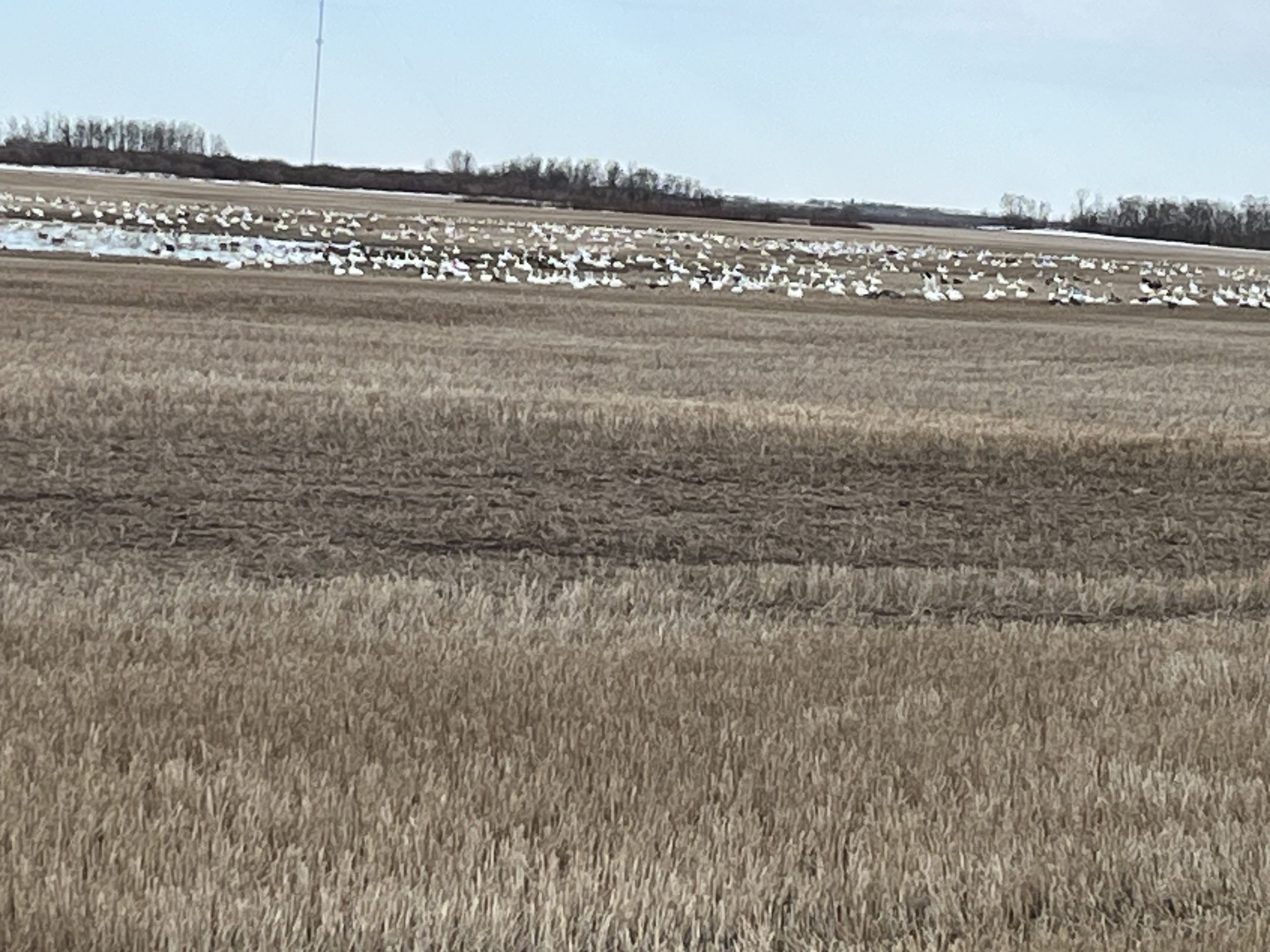
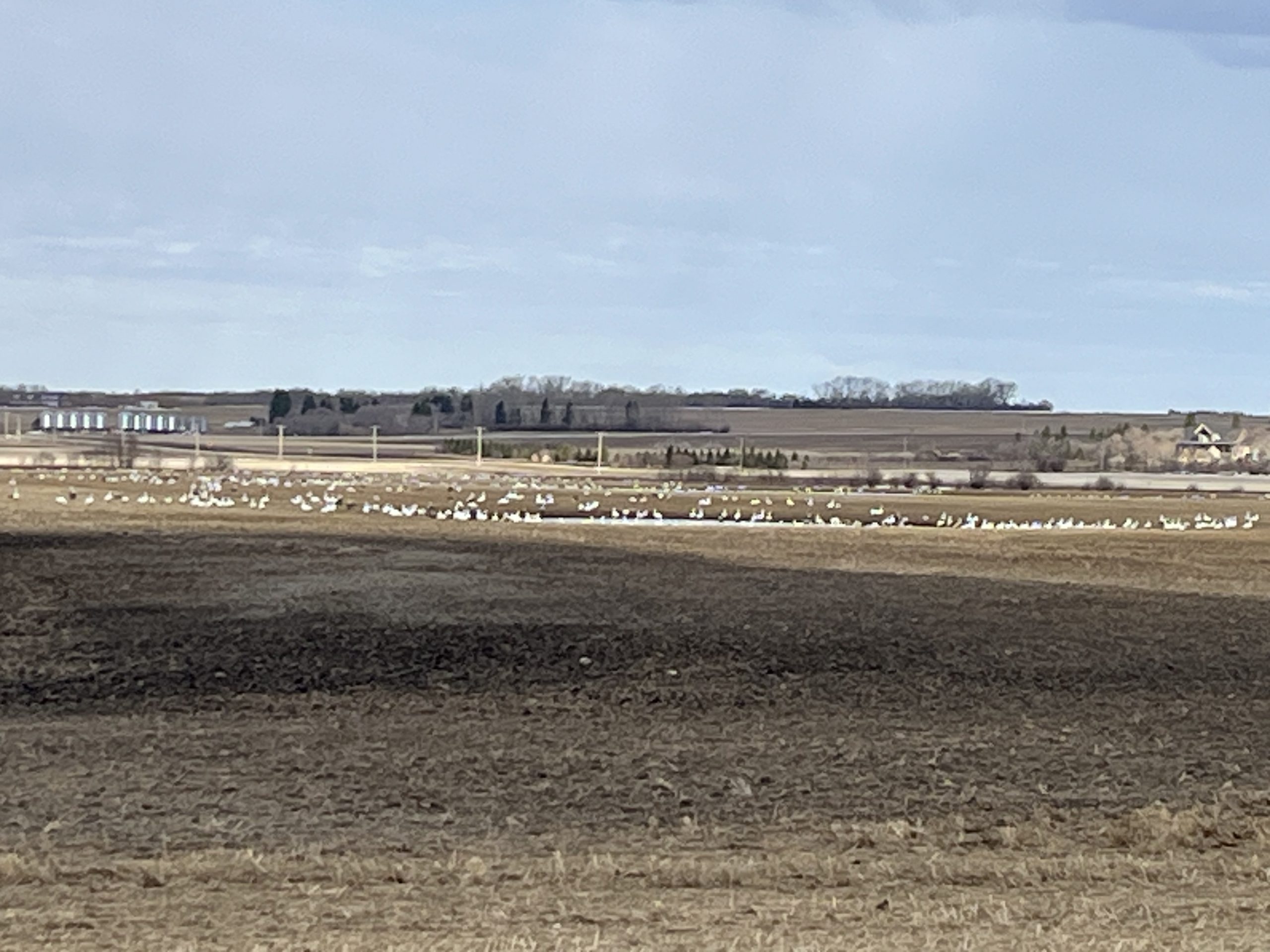
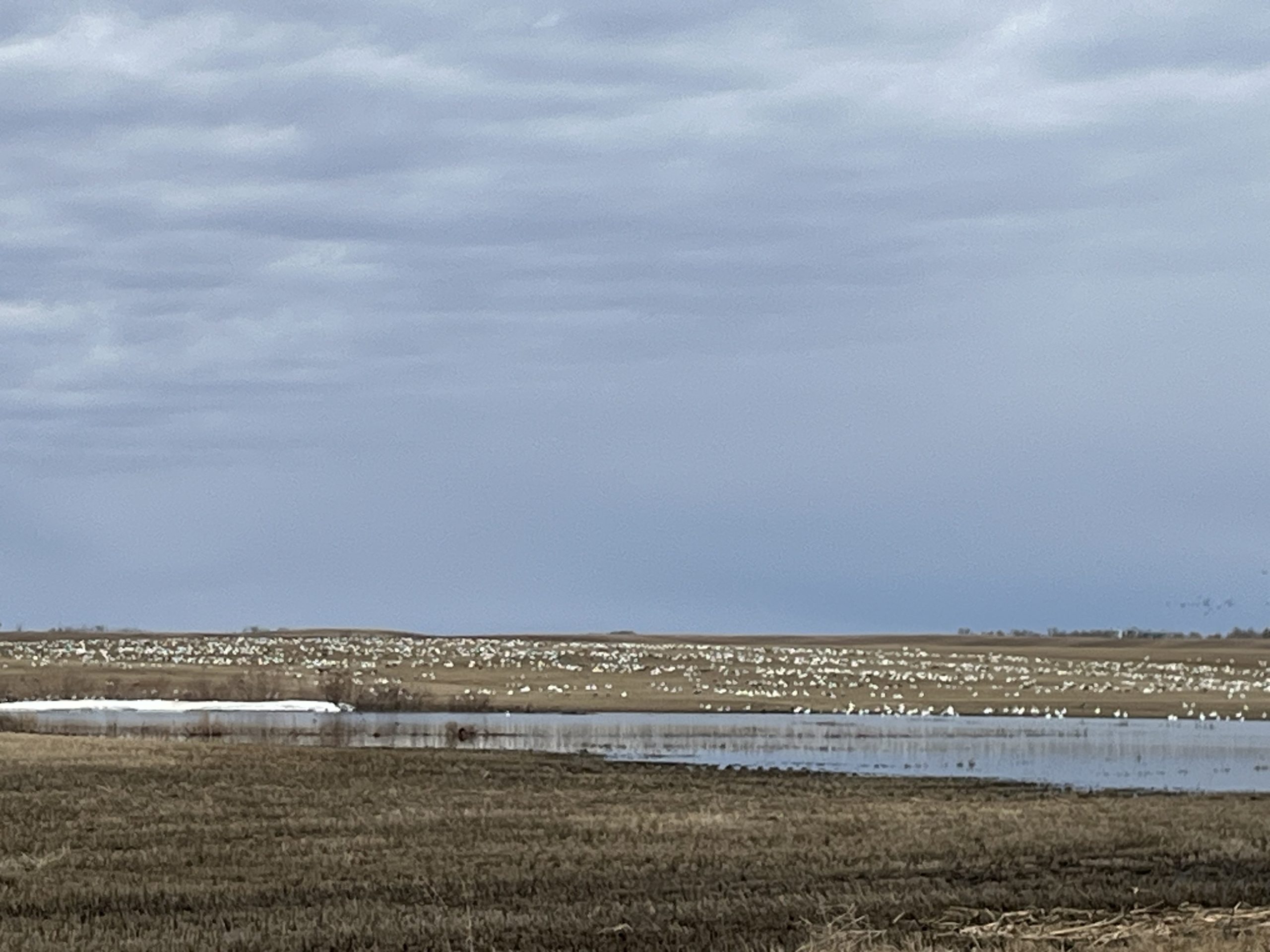
On a couple of recent scouting runs, I took a few images of some fields. Here are a few observations based on the fields. Some of these images where taken with a phone camera on high zoom so the quality is not great.

In the image below, while the total number of geese is only about 1000 (image does not show entire field), there are a good number of young birds. You can see young snows as well as young “Eagle Heads” (blue phase Snow Geese). This could be a good shoot for 3 to 4 hunters.

At first glance, the image below appears to be a small number of dark geese, too few to hunt. But at the back end of the field, you can make out a blotch of white, snow geese.  Watching this field for about 15 minutes I noticed a steady stream of Snows and Canadas landing in the next field, so I went to have a look.

The next field to south was building up with a good number of Canadas.

…and more and more Snow Geese. It’s hard to make out the ducks in the images but there were a few hundred Mallards as well. This could be a decent shoot. I would recommend giving it a another day of observation if you want to hunt a big number of Snow but if you are after Canadas and ducks, its ready.

This is the next morning, the same field as the first image above. Definitely more dark geese and the Snows were about the same spread across the field.

The geese did not gather up in one large group, the were spread out across the field suggesting the field may be approaching being cleaned out so hunt this field soon.

The Trout of 1000 Casts

August 25, 2025 / galen / Fishing, Fly Fishing, Outdoors

I’m a huge fan of outdoor scenery. Trees, bush, hills, open plains, lakes, rivers, sky, deer, coyotes, birds, and fish. On a recent fly fishing trip to some of the most scenic rivers of southern Alberta, we didn’t take many pictures of the fish. It was a fishing trip, primarily, when we started. The consolation prize was spending 4 days in some beautiful scenery and walking away with some some outstanding images of the scenery, and some brown trout.

When I play golf, I play purely for the enjoyment of the activity. I don’t play enough to be good at golf so my score is somewhat irrelevant, and I have modified my scoring system to only keep track of the strokes that go in the hole. My personal best, achieved a few times, is 9 on a nine-hole course, and 18 on a full round. I have adapted this scoring system from spending much more time fishing compared to golfing. I don’t know of anyone who counts their casts, only the fish caught. But after my most recent fly-fishing trip, I decided that an estimate of the number of casts to catch the first fish was appropriate.

1000 casts per Brown Trout. That’s as good as I can calculate. We tried to take a guess at the number of casts we made. Cast, float, mend, mend, mend, nothing, cast. We figured about 500 per day. That makes for The Trout of 1000 Casts.

This was a good fish. A fifteen inch Brown Trout. A good fish on any day. Quite a bit smaller than the twenty incher I caught just up the river and around the bend just over a year ago, but I would have been happy to break the curse with something half the size. This was well into day three of the trip, approximately 1000 casts into the adventure. We fished the Oldman River Monday evening. This same Waterton River all day Tuesday, and now on Wednesday we were well into the afternoon before this Trout finally committed to the hopper fly.

We spent the better part of the previous 36 hours watching the occasional Brown Trout bump our flies. Rising and splashing at the back of the fly, but rarely a full scale bite, rarely that tug on the line confirming a fish has taken the fly. Hoppers flies were the most popular flies to attract some interest. We tried many others, caddis, adams, drakes, wooly buggers, and dropping nymphs under our hoppers. Most of the “action” that kept us going, and hoping, was when we could see a Brown Trout turn and follow a hopper fly downstream through the riffles, only to abandon the chase without chomping on the fly.

We ran into a few other anglers on the Waterton river, they reported similar low levels of bit action. As one commented, “caught a nice little Brown around the corner and just missed a monster”.  The weather was hot, highs around 30 degrees Celsius and little cloud cover. We had hoped the early morning and evening, a bit cooler, would provide us the bulk of the action. We saw limited improvements in fish activity, a few isolated rises, but no sustained feeding.

So fish on we did, and cover ground, or water, across the slippery rocks and spending hours bracing against the currents. We tracked over 13000 steps per day, about 12000 of those in waders. We kept searching for that hot spot where the fish were feeding. Trying fast water, through the riffles and rapids, to the foamy seems, to the deep pools at the end of the fast water. Other than the weather, there was no hot spot.

What we did experience was a good time to practice scenery photography skills and appreciate the outdoors experience. Living in central Saskatchewan, we don’t the same topography and the same types of water features. 1000’s and 1000’s of lakes and rivers, yes, and I will fish as many of them as I can. But southern Alberta offers the lure of several wild Trout species to be caught in the flowing waters, including my favorite, Brown Trout. I didn’t go back without landing at least one of these species, and missing a few others I should have caught (that’s just how fishing goes). At most of the stops on the rivers, I risked the possibility of dropping my phone in the flowing water and captured some images worthy of my laptop wallpaper and sharing with friends and family.  I have a gallery of some of my favorites below. Hope you like the visuals as much as I do.

Waterton River


Oldman River


2021 Make Plans for the Outdoors

January 4, 2021 / galen / Camping, Fishing, Hunting, Outdoors

As we all know, 2020 was not a good year for many activities, many businesses, and many people.  With 2020 in the rear view mirror, we can now look forward to plans for 2021 and making plans for finding a way to enjoy our favourite outdoor activities.  In 2020 we were bombarded with terms such as pandemic, social distancing, restrictions, and more.  These are all still relevant, likely quite deep into 2021.  So we can’t forget about critical health safety measures, but we can safely get involved in hunting, fishing and camping activities in 2021.

The group gathering guidelines are a moving target so we will simply say make sure you know the guidelines for your province.  Knowing that, you can still make plans for getting outdoors in 2021.  When you get right down to it, getting out on the ice, out on the lake, out in a field, or in front of a campfire, can all be done safely and keeping our distance from other groups.

Sometimes the reality of the situation can be a bit discouraging.  I’d like to plan my spring fishing trip up north with our regular group of 8 to 10 fishing buddies.  Reality is that we can’t plan this way, but we can make plans with our own families to get outdoors.  So maybe the groups are smaller, but for good reason, so that we can get back to our larger group activities soon, and safer.

I often spend a number of days in the fall, getting to the field 2 hours before dawn, laying out four or five hundred decoys, setting up the blinds, and knocking down a mixed bag of snow geese, ducks, and Canada geese, maybe even a prize specklebelly goose.  I don’t have the manpower within my family circle to do as often, but with with myself and another family member, we can put out a decent decoy spread and still enjoy a morning or an afternoon hunt.  Maybe by the time fall comes to the calendar,  we will have the pandemic under control and the size of the hunting group can expand.  Until then, we need to stay safe to contain the health risks.

2021 and the health crisis carrying over from 2020 should not prevent you from enjoying your time outdoors, but your planning might need to be done with smaller groups.

Stay safe so we can all get together again in a better future.

Saskatchewan Camping Online Reservations Open

April 17, 2017 / galen / Camping, Outdoors

Online camping reservations for all Saskatchewan Provincial Parks are now open on the Sask parks Reserve-A-Site page at: www.saskparks.net/Reserve-a-Site.

Fees have been increased this year but with plenty of hype around the Canada 150 celebrations, expect demand to still be strong for camping spots this year.  The fee increases are across the board including individual campsites, group camping and seasonal campground reservations.

The dates for online reservations opening are:

  • April 4: Blackstrap, Pike Lake
  • April 6: Echo Valley, Rowan’s Ravine.
  • April 7: Duck Mountain, Good Spirit Lake, Greenwater Lake.
  • April 8: Crooked Lake, Moose Mountain.
  • April 9: Cypress Hills.
  • April 10: The Battlefords, Saskatchewan Landing.
  • April 11: Meadow Lake.
  • April 12: Bronson Forest, Chitek Lake, Lac La Ronge, Makwa Lake.
  • April 13: Candle Lake, Narrow Hills, Great Blue Heron.

We Bought a Cabin

August 22, 2016 / galen / Life at the Cabin, Outdoors

Episode #1, We Bought Cabin

And so it begins. It’s late summer of 2016 and we have become cabin owners. We are also the owners of a 5 year project list to overhaul, renovate, update, and change every square inch of the property, from the lake shore, to the yard, to every surface and fixture inside the cabin. We think we are reasonably handy, semi-crafty, and quite resourceful. We shall see how the project list goes. I’m hoping to chronicle some of the experience here. In the event you find it interesting, while I’m glad to have entertained. In the event you find it helpful, well I’m glad to have provided the value of my experiences. In the event we never see you again past this point in the first episode, well, thanks for sticking it out for almost a paragraph.

Why Episode #1?

I’m a marketer by trade so to follow the format of today’s popular streaming services, Season x, Episode Y just seemed to be a natural fit with how people are now consuming content.  The word episode also captures what I anticipate to be a series of successes and a few failures.  The 5 year project list seems to be guaranteed to deliver a few minor injury reports, a few marital disagreements, and a great deal of good times that far outweigh the pain, sweat, and dollars it’s going to cost.  By the way, when we got serious about this particular property, my project list had about 16 items on it.  The official list, including my 16 items, has grown to about 50 items.  I still contend the original 16 were enough.  Oh yes, 5 of those items were definitely to take off the months of June through August and enjoy our progress, 1 for each year of our 5 year project.

The Back Story

I’ll save you most of the details of our personal lives leading up to the cabin purchase, most of them.  Even though I’m sure you would find them fascinating (we consider ourselves the world’s most interesting people based on a sample of 2).  By the way, I’m incredibly humorous and my wife agrees, seldom, but often enough to keep me trying.

Not our actual trailer, but this looks a picture out of the family archives.

For many years my wife and I had talked about the mutual desire to own a cabin. She grew up with a cabin in the family. I grew up with family camping trips in a tent trailer. My in-laws sold the cabin, the year before we were married. I only had the opportunity to experience it as a visitor, not as a semi-resident.  We did both the tent trailer camper experience and the cabin rental/borrow experience enough times to know we enjoyed both.  The cabin experience was far above the camping experience for us.  Busy jobs and busy kids, with sports activities that kept us driving to every hockey rink, baseball field, basketball court, wrestling meet, volleyball court, and football field in all of the land, made it obvious to us that we did not have the time to fully immerse ourselves in the Life at the Cabin lifestyle.  Instead we bought a sport boat and made day trips to the north, south, east and west to spend time on the water when we could.   Often we would brings friends with us, or meet up with family and burn through a tank of gas, or more, and return home at the end, exhausted and happy.

The New Boat

Family at the Lake


The planets started to align when we had the first two kids in university and our third (and last) in grade 11, with the end of high school and minor sports over the horizon and around the bend, it was close enough. We started to get serious in our talks about about cabin ownership.  Also aligning was our financial ability to afford a cabin.  The house mortgage was on it’s last few months, money we could redirect into retirement savings, or into life enjoyment now.  We choose a real estate investment with the potential to be both.

Back to Today, Buying that Cabin

We knew our criteria, we had a budget, we had a list of properties to explore.  I suppose everyone has their own list of criteria for a cabin property.  We certainly had ours:

  • * lake front
  • * 4 season
  • * within 1 hour drive
  • * 3 bedrooms
  • * no stairs
  • big deck
  • wide open yard
  • move in ready
  • dock and boat lift included

‘*’ the must have list

Our search began. We soon found out that our “enormous budget” didn’t put us in the category of walking in, no worries, and just relaxing.  We saw cabins that were best renovated with a Wylie Coyote bundle of dynamite, cabins with endless stairways from cabin to water, cabins that were nearly perfect, minus a must have from the list, an

First view of the property

d cabins that were perfectly suited for other families.  On about cabin inspection tour #3 we had a couple properties lined up that had possibilities and we stumbled across a for sale by owner cabin that was not listed online anywhere.  With no one home, we took a walk about and overgrown yard told us a couple things.  The owners didn’t there very often and we had to get our real estate agent on this one.

It had that “cabiny” feel to it, the “cabiny” look, and the potential to be the one.  A brand new two level deck also had our interest.  After all, you don’t buy a cabin to spend your time inside.  I can do that at home quite nicely.

A week late and our real estate agent had the keys we had our inside look at the property we eventually bought.  It was during that inside tour that the project list grew, grew some more, and extended past cutting the lawn to a 5 year list of renovations and overhauls.

In Episode #2, The Clearout, our discoveries begin.


Add A Campground Rating

December 2, 2015 / galen / Camping, Outdoors

Did you know you can add your opinion to the Campground ratings section and help other campers? On our provincial camping pages we include a campground rating and comments area.

Did you like your campsite? Were the facilities clean and modern? Was the firewood dry? How was the playground? Is the fishing good at the nearby lake or river?

Your opinions and comments will help future families and other campers pick the campground that is best suited to what they want from their outdoors adventure camping experience.

  • Alberta Campground Ratings
  • Saskatchewan Campground Ratings
  • Manitoba Campground Ratings

Outdoors Songs

July 28, 2015 / galen / Fishing, Hunting, Outdoors

Of all the topics in the world to write songs about, the great outdoors seems to have been mostly overlooked. It’s just plain difficult to find a song, let alone a good song, about hunting or fishing. Yes, there are a few “joke songs” out there, songs that rank up there with “Snoopy and the Red Baron”, and hunting or fishing show opening songs, but actual songs by actual brand name artists are hard to come by. It’s not hard to find songs about girls, songs about boys, songs about cars, and summer, and parties, and all other popular topics. So, we have scoured the internet and our own personal music libraries, to give you a list of songs for hunting and fishing. Some of these are great, some are crap (personal opinions), but you know what they are about by the titles. Some of my personal favorites come from Ted Nugent, who can quite regularly be found on outdoor shows having a great time shooting black bear in Saskatchewan with his “Wackmaster” bow or shooting ducks off his back porch in Michigan. If you want a great album, pick up “Spirit of the Wild” which includes many of the songs listed. A few of these songs take the light hearted approach, such as Brad Paisley’s “I’m Gonna Miss Her”. We have a second list of songs that might be considered, but aren’t really, about hunting or fishing, but mention animals, or lakes, or forest, or such.


  • Fred Bear – Ted Nugent
  • I Just Wanna Go Hunting – Ted Nugent
  • Gone Fishing – Downchild Blue Band
  • My Bow and Arrow – Ted Nugent
  • Spirit of the Wild – Ted Nugent
  • I Shoot Back – Ted Nugent
  • Tooth Fang and Claw – Ted Nugent
  • I’m Gonna Miss Her – Brad Paisley
  • Mossy Oak Song (Pass It On) – Tracy Byrd
  • One Damn Deer – from the Bob and Tom radio show
  • Mighty Manly Hunting Men – Da Yoopers
  • Thirty Point Buck – Da Yoopers
  • 2nd Week of Deer Camp (part 1) – Da Yoopers
  • 2nd Week of Deer Camp (part 2) – Da Yoopers
  • Deer Hunter’s Widow – Da Yoopers
  • Gone Fishing – Brad Paisley
  • Fish Fight Song – Da Yoopers
  • 40 Pound Crappie – Da Yoopers
  • Too Drunk To Fish – Ray Stevens
  • Fishing On T.V. – Brian Regan
  • Mama’s Got The Catfish Blues – Tom T. Hall
  • Hunting The Duck – Buddy Wasisname and The Other Fellers


The songs that didn’t quite make the list:

  • Take Me to the River – Al Green
  • Catfish Blues – Jimi Hendrix
  • Of Wolf and Man – Metallica
  • Sweet home Alabama – Lynyrd Skynyrd
  • The Trees – Rush
  • Bullfrog Blues – Dave Hole
  • The Spanish Archer – Deep Purple
  • The Hunter – Free
  • John the Fisherman – Primus
  • Barracuda – Heart
  • Great White Buffalo – Ted Nugent
  • Hibernation – Ted Nugent


Bonus Day

April 12, 2015 / galen / Outdoors

I’ve been practicing the idea of Bonus Days on business travel for a couple of decades now. Here’s how it works.

You have an upcoming business trip, the business portion of the trip begins on Day X and ends on Day Y. You add another day to the trip, after Day Y, and schedule some outdoor activity for that day. It’s a great way to unwind after a week of meetings, or a conference, or whatever your business requirements happened to be.  The great thing is that the majority of your personal expense is already covered by your company, and the additional expenses you will incur yourself are minimal compared to footing the bill yourself.

Where it Started

I’m sure I’m not the first one to come up with this idea, but here’s how it came to me.  I was at an international dealer conference for the company I worked with.  Three days of meetings and presentations along with social functions, requiring that I, and my co-workers, were on the clock from dawn until midnight.  The conference was at a very nice resort on the Mexican Mayan Riviera.  My wife came along for the trip, relaxed on the beach, or by the pool, with a cool drink by her side.  Other spouses were along and they had a great time while I watched the palm tree sway in the breeze through the windows, made presentations, and lead dealer forums.  The final night of the conference was the big awards gala.  Next morning we packed up and headed to the airport, passing beach resort after beach resort.  I realized that the company has paid my way, airfare being the biggest expense, and I paid them back working 18 hours a day.  The next conference was already being planned, in a similar location, and I had a brand new plan.  My wife and I added a couple extra days, at our expense, to the end of the trip the following year, went snorkeling, toured the Mayan ruins, and drank rum on the beach.  It was the cheapest breach holiday ever.

Before or After

I know some people that have the same Bonus Day idea as I do, but they take the Bonus Day before the travel.  Often when I travel I have a substantial amount of new material to develop or prepare, and every day/hour/minute of preparation is often needed, especially last minute changes and pre-meeting run through.  This makes the idea of a Bonus Day more attractive, as it’s the prize after the hard work, it feels more like I have earned it at that point.

The Bonus Day Plan

Now the Bonus Day Plan is part of my regular travel routine.  It’s not hard to find an outdoor experience near to where you are traveling.  Here are a few examples of Bonus Days I have added:

  • snorkeling at Turks and Caicos
  • golfing in Scotland
  • fly fishing for trout in Alberta
  • Skiing in Ontario
  • catamaran and snorkeling trip in Jamaica
  • golfing and carousing in Vegas
  • relax on the beach in Bahamas
  • desert tour in Hummers in Phoenix
  • mountain tail quad trip in Puerto Vallarta
  • surfing in Hawaii

For all of these Bonus Days, the out of pocket expenses to my self have been limited to a hotel bill, meals, plus the cost of the activity itself.  It has been a cheap way to do a few things that would otherwise cost me a few thousand dollars.

What is your Bonus Day Plan.  Don’t you think you have earned it?

1234

Recent Posts

  • Security Cams are Really Game Cams
  • On the Quest for 1000 Fish This Summer
  • End of Summer Day of Sadness – Putting the Sea Doos on the Trailer Solo
  • Looking Forward to Every Sunrise
  • Fly Fishing for Catfish

Categories

  • Bear Hunting
  • Camping
  • Deer Hunting
  • Duck Hunting
  • Fishing
  • Fly Fishing
  • Goose Hunting
  • Hunting
  • Ice Fishing
  • Life at the Cabin
  • Outdoors
  • Snowmobiling
  • Uncategorized

Subscribe to Updates

Subscribe to our Posts