
Today’s lesson in remote boat repairs was definitely a lesson learned through recent experience. The lesson is pretty simple, if the boat is in a remote location (such as at your cabin, especially your dock, not your driveway at home), bring all the parts, including extras, and smaller and larger.
It’s expensive and time wasting to have to drive 100+ km to get a few $3 parts because the dealer told you the wrong part initially, really its a lesson in any remote work, bring extra. You can return the unneeded parts at a later date, if they are expensive.
This learning experience started on the day we finished putting in the dock and boat lift. With those in place, time to launch the Sea-Doos and boat. The boat was sluggish, very heavy feeling, like it was weighted down in the back. Flipping the back bench seat up to expose the engine compartment revealed it was full of water. Several possible reasons, that I could think of.
- Drain plug damaged or not screwed in. I had checked it and my wife had checked it. Unlikely.
- Engine drain plugs damaged or not replaced. I’ve never not put them back in, so also unlikely.
- Loose or damaged coolant hose.
I ran the bilge and that helped reduce the amount of water and I was able to get to the cabin and park on the lift. Some investigation followed and I ruled out the main drain plug as well as the engine drain plugs. When running the engine with the leg in water for cooling water intake, I could see water spraying from the right side of the engine (when facing the front). To me, this meant most likely a loose or damaged hose. I lowered my phone down to take a video of the area and I could see it was entirely something else.
That the hole left behind when an engine frost plug (many other names) blows out. Likely due to a bad job of winterizing by me. I needed a part.
The boat motor is a Chevy motor, branded a Tahoe Bravo but it’s a Chevy 4.3 litre engine. I was taking my wife’s Chevy to the dealership for a free oil change so I figured I would get the part there. They did not have one but suggested Bumper to Bumper and provided me a part number. So that was my next stop and then off to the cabin later in the day for some fishing and work around the yard.
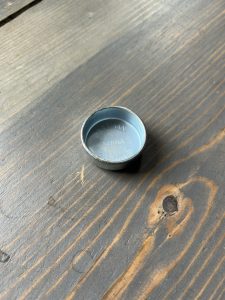
Inexpensive part. Tough spot to get at, underside of the engine, restricted area. That didn’t matter as the part spec’d by the parts expert at the Chevy dealership was the part that would fit my wife’s truck, not the much older engine in the boat. Yes, I told him what I needed it for, and he gave me the wrong part number. Of course, I only found this out when I attempted to test fit the part, on the boat, at the cabin. So it was back to Saskatoon Bumper to Bumper to get the proper part. A 2 hour round trip, plus time in store, so 2-1/2 hours of unproductive time. I did prior to the trip, call other suppliers closer but nobody had then in stock. I did think ahead a little bit. It’s a really tough spot on the engine to access. Probably far easier if not for all the fiberglass of a boat in the way, say if on a vehicle on a lift. Impossible to get 2 hands down there and to see what you are doing. So the repair process was going to be awkward and most by feel rather than by sight. So, again, thinking ahead, I bought the next 3 sizes of the part, 1-1/2″, 1-5/8″ and 1-3/4″, and 2 of each. Only a few $’s each part and much less of an expense than another trip to get another size.
After many attempts that day to get the part installed, I realized that there was no way I could think of to get enough force on the part, at the right angle, to tap this into place. I constructed a few elaborate mechanisms to hold the part in place, most consisting of a wooden stake so I could position the part, duct taped to a ratchet extension, to a socket, duck taped to the part I was trying to tap in. I simply cold not get a long enough hammer swing to provide enough force, to get the part to seat into the hole. Many other combinations of shorter shafts, and my max swing range was about 2-1/2″ inches. I gave up for the day, but began to devise new combinations of pieces and wood, and tools to try again the next day, that day was a failure as well.
Finally I decided to extend my parts search on the wonderful tool of Google and came across another part that showed some promise. It was a rubber based piece that expanded when the nut was turned.
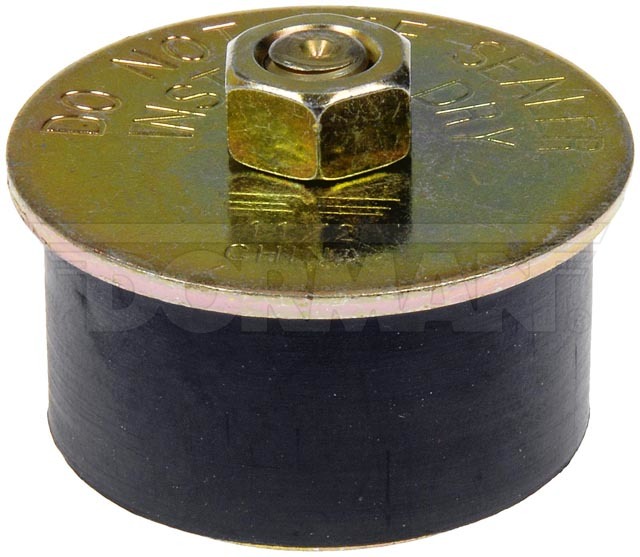
This looked like the last possible solution, but it was Saturday evening, no time to get to the parts store, which was closed on Sunday. I had a buddy coming to town on Monday, to go to the cabin, to go fishing. So Monday morning I went to the parts store and bought the recommended size, based on the other part that I knew was the right size, plus on smaller, plus on larger. Within 15 minutes of arriving at the cabin that evening, all supplies had been unloaded and we had the part in place and tightened with a socket wrench and the boat was running, no extra water gushing out of the engine block. The Fishing Trip, which had been in jeopardy, was on. We fished. We ate well, and I was relieved, after much frustration, and an important lesson learned.
Next time I have a boat repair, or any repair of any type, at the cabin, I will have all the parts, in a range of sizes, bring too many tools, and hope I can get the repair done.