Prairie Outdoors
  • Email
  • Facebook
  • RSS
  • Home
  • Outdoors Blog
  • Campgrounds and Camping
    • Alberta Campgrounds
    • Saskatchewan Campgrounds
    • Manitoba Campgrounds
    • Camping Photo Contest
    • Country Building Photo Contest
    • Boats and Trailers
    • ATV and Snowmobile Rentals
    • Campground Reservations
  • Hunting
    • Wildlife on Camera 2026
    • Hunting Photo Contest
    • Outfitter Guides and Lodges
    • Buy Hunting Licenses
    • The Campfire
    • Our Favorite Places
    • Know Your Species
    • Saskatchewan Whitetail and Mule Deer Seasons
    • Deer Antler Scoring Whitetail and Mule Deer
    • Scoring Your Black Bear Trophy Skull
    • Moose Antler Trophy Scoring
    • Hunting Dogs
  • Fishing
    • Fishing Photo Contest
    • Buy Fishing Licenses
    • Fishing Camps and Lodges
    • The Campfire
    • Our Favorite Places
    • Ice Fishing
    • Pike & Walleye Weight Chart
  • Outfitters
    • SK Deer Hunting
    • SK Moose Hunting
    • SK Bear Hunting
    • SK Goose Hunting
    • Alberta Outfitters and Guides
    • Saskatchewan Outfitters and Guides
    • Manitoba Outfitters and Guides
    • Trip Finder
  • Hunts For Sale
  • Games
    • Outdoor Hangman
    • Outdoor Trivia
    • Outdoors Trivia 2
    • Survey – Broder Buck vs Hanson Buck
    • Survey – Fishing – Keep or Release
    • Survey – Fishing – Lefty or Righty
    • Survey – Shotgun for Geese
    • Survey – Fishing – Pike vs Walleye
    • Survey – Fly Fishing vs Spincasting
    • Survey – Upland Birds vs Waterfowl Hunting
  • Advertise
    • Advertise Your Outfitter Business
    • Advertise Your Campground
    • Outdoors Web Site Development
    • Sponsor Opportunities on Prairie Outdoors
    • Advertise Your RV Dealership
  • About
Search the site...
  • Home
  • Hunting

5 Tips on Scouting for Geese

October 30, 2025 / galen / Goose Hunting, Hunting, Outdoors

I spent a dozen years as head guide for a waterfowl hunting camp in central Saskatchewan. As the spotter, you have sole responsibility for selecting and securing hunting permission for a field where your hunters will set up for the next shoot. During that time I learned a few things about scouting for geese. Some where learned the hard way, by setting up in a field and seeing no birds on approach and others simply from years and years of observation. In most spotting situations, if you have been actively spotting for days and weeks, you will have far greater knowledge and will be able to make a more informed decision. If you are out on a Friday night looking for a Saturday morning shoot, you will have far less knowledge and there is greater risk in the field you pick.

Geese Scouting Tip #1: Timing.

How many days have the birds been in the field? Are you spotting them in the morning or evening spotting? If you have consistently seen geese for a couple days, or at least the morning and evening of the same day, most likely those birds will return to the same field for the following morning and probably the afternoon as well. Morning are more consistent than afternoons. It is after the morning feed that a flock has a chance to pick out other fields and if birds are going to bounce from one field to another, likely that will be the afternoon. If the birds are pushing 3 or 4 days in the same field, they may have reached the limit or ate up most of the grain and will be moving fields soon.

Geese Scouting Tip #2: In-Bound Flock Sizes

Did the birds arrive in 1 flock or many smaller. If you saw the birds arriving at the field, did the flock on the ground build gradually? Ideally you will want a flock that arrives in many smaller groups. As the number of birds in the air increases, so too does the number of eyes looking down at your decoys and blinds. Too many eyes increases the chances of seeing something that sets off the alarms. Small groups arriving over time give you time to shoot and reload while other groups are still far enough away to not be scared off by the sounds of gunfire. A break between groups also gives the dogs a few moments to round up the dead birds on the ground.

Geese Scouting Tip #3: Variety

Are you hunting one species or mixed bag? Are the any ducks in the field? Simply put, more variety equals more certainty of opportunity to shoot. Snow Geese, Canada Geese, ducks, and Specklebellies may all have their own roosts and will fly at different times of the morning or afternoon. Geese will travel long distances from the roost to the feed field while ducks will typically feed closer to the roost so having a good number of ducks in the field increases your chances even if the geese do not cooperate. If there are Snows and dark geese in the field, and one of those species skips your field, you still have chances of a good hunt.

Geese Scouting Tip #4: Location of the Roost

How far away is the roost they came from? If the roost is very close, within one field, sometimes two, then the sounds of gunfire may be close enough to bust the roost and send the geese in another direction. If the wind direction is carrying the sounds of the shotguns away from the roost, then proximity is less and less an issue with the increase in wind speed. If you trace the birds back to a roost a long distance away, and the weather remains consistent between spotting and your next hunt, then that’s a positive. But there is a significant change in weather, such as a large increase in wind or a shift in direction, or rainfall, the geese will be less likely to travel a large distance and will find a feed field closer.

Geese Scouting Tip #5: Young Birds

How many grey snow geese or how many noticeably smaller greater Canadas are in the family groups? A high proportion of young birds is one of the signals of the end of migration approaching and you will want to hunt ’em now before the weather changes. Geese flocks with high numbers of young birds, 25% or higher especially, will hold in place as long as they can, or make short migration hops to give the young birds more time to gain strength for longer flights. However, if you see a high number of these juvenile birds and there is an approaching cold front, expect to see the Snow Geese heading south in the morning, or even after an afternoon feed if the sky is clear and there is good moonlight. One last observation on young birds, they do not have the wisdom of the older birds and will often break off from the flock to check out a decoy spread and can make for some high number shoots later in the migration.

Bonus Material – Field Views

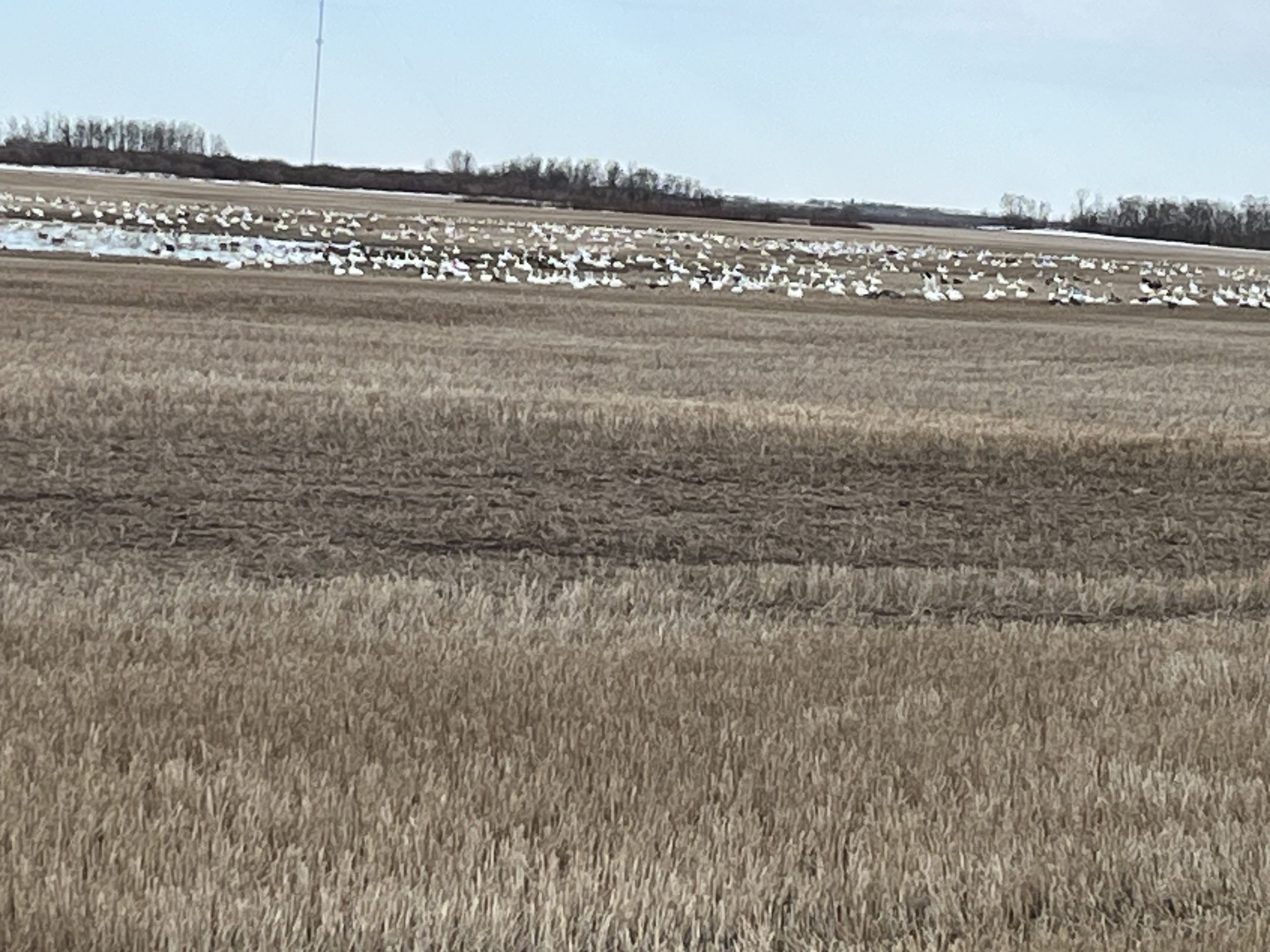
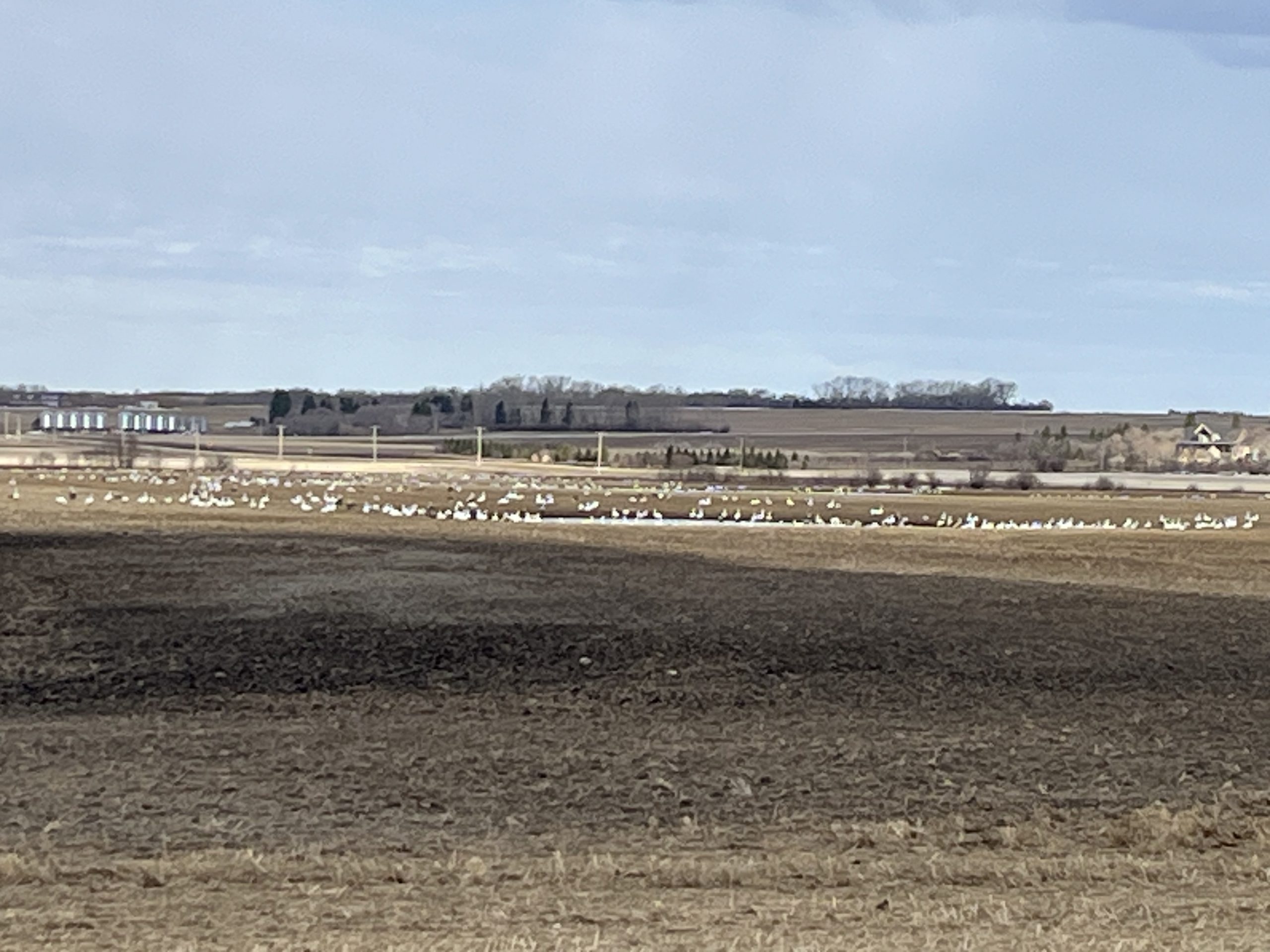
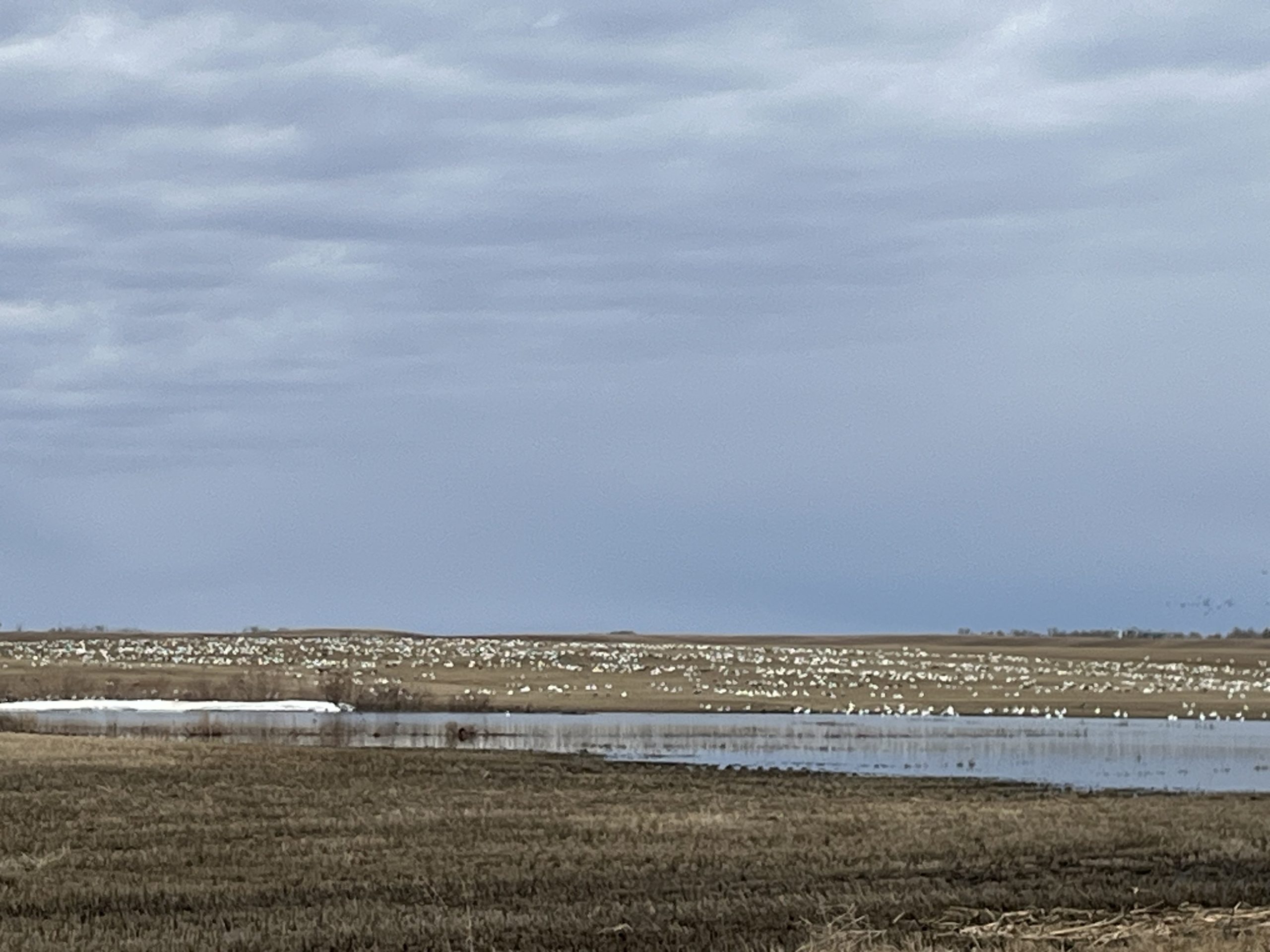
On a couple of recent scouting runs, I took a few images of some fields. Here are a few observations based on the fields. Some of these images where taken with a phone camera on high zoom so the quality is not great.

In the image below, while the total number of geese is only about 1000 (image does not show entire field), there are a good number of young birds. You can see young snows as well as young “Eagle Heads” (blue phase Snow Geese). This could be a good shoot for 3 to 4 hunters.

At first glance, the image below appears to be a small number of dark geese, too few to hunt. But at the back end of the field, you can make out a blotch of white, snow geese.  Watching this field for about 15 minutes I noticed a steady stream of Snows and Canadas landing in the next field, so I went to have a look.

The next field to south was building up with a good number of Canadas.

…and more and more Snow Geese. It’s hard to make out the ducks in the images but there were a few hundred Mallards as well. This could be a decent shoot. I would recommend giving it a another day of observation if you want to hunt a big number of Snow but if you are after Canadas and ducks, its ready.

This is the next morning, the same field as the first image above. Definitely more dark geese and the Snows were about the same spread across the field.

The geese did not gather up in one large group, the were spread out across the field suggesting the field may be approaching being cleaned out so hunt this field soon.

2021 Make Plans for the Outdoors

January 4, 2021 / galen / Camping, Fishing, Hunting, Outdoors

As we all know, 2020 was not a good year for many activities, many businesses, and many people.  With 2020 in the rear view mirror, we can now look forward to plans for 2021 and making plans for finding a way to enjoy our favourite outdoor activities.  In 2020 we were bombarded with terms such as pandemic, social distancing, restrictions, and more.  These are all still relevant, likely quite deep into 2021.  So we can’t forget about critical health safety measures, but we can safely get involved in hunting, fishing and camping activities in 2021.

The group gathering guidelines are a moving target so we will simply say make sure you know the guidelines for your province.  Knowing that, you can still make plans for getting outdoors in 2021.  When you get right down to it, getting out on the ice, out on the lake, out in a field, or in front of a campfire, can all be done safely and keeping our distance from other groups.

Sometimes the reality of the situation can be a bit discouraging.  I’d like to plan my spring fishing trip up north with our regular group of 8 to 10 fishing buddies.  Reality is that we can’t plan this way, but we can make plans with our own families to get outdoors.  So maybe the groups are smaller, but for good reason, so that we can get back to our larger group activities soon, and safer.

I often spend a number of days in the fall, getting to the field 2 hours before dawn, laying out four or five hundred decoys, setting up the blinds, and knocking down a mixed bag of snow geese, ducks, and Canada geese, maybe even a prize specklebelly goose.  I don’t have the manpower within my family circle to do as often, but with with myself and another family member, we can put out a decent decoy spread and still enjoy a morning or an afternoon hunt.  Maybe by the time fall comes to the calendar,  we will have the pandemic under control and the size of the hunting group can expand.  Until then, we need to stay safe to contain the health risks.

2021 and the health crisis carrying over from 2020 should not prevent you from enjoying your time outdoors, but your planning might need to be done with smaller groups.

Stay safe so we can all get together again in a better future.

Spring is Here!

March 20, 2019 / galen / Camping, Goose Hunting, Ice Fishing

Welcome to the first day of Spring 2019! After a very cold Winter a warm start to Spring is a very welcome change. Today’s high in Central Saskatchewan is plus 5. Yes, a plus in front of the number. There are signs of spring everywhere. More people out walking, a few Canada geese pairs flying overhead, water running in the streets, fields starting to show under their blanket of snow. Blue skies and sunshine in the forecast. Looks like a great rest of March to come.

More signs of Spring are the provincial campground reservations systems are all available now.

Alberta Campgrounds: https://reserve.albertaparks.ca/
Saskatchewan Campgrounds: https://saskparks.goingtocamp.com/
Manitoba Campgrounds: https://prspub.gov.mb.ca/

Note that not all campgrounds in all parks may be available yet as provinces often stagger the open dates to manage the volume.

It’s officially Spring Snow Goose season, but don’t head out spotting yet. The white geese are still several weeks away. We wont see them until some of the water bodies open up as their push north depends on being able to find both water to roost and food in the fields. I was out ice fishing yesterday, still 3-1/2 feet of ice to auger through so big water is going to be awhile still.

Speaking of ice fishing, March is typically the best month for ice fishing so get out while you can. In most southern zones, ice shacks should have already been removed but that shouldn’t stop you from spending a sunny day drilling holes and catching fish.

Geese in the Air

March 20, 2018 / galen / Goose Hunting, Hunting

It must be spring, there are geese in the air.

Canada Geese March 2018

March 10th at about 2:00 in the afternoon I saw a flock of 25 Greater Canada Geese flying over Saskatoon on their way to the only open water around for a few hundred miles, the river. There were a couple small groups of 3 to 5 birds around as well.

Now if I was a bird, and I could fly, I would still be down south where the fields are bare and the water is warm.

Fred Bear’s 10 Commandments of Hunting

May 4, 2017 / galen / Deer Hunting, Hunting

Fred Bear’s 10 Commandments of Hunting:

  1. Don’t step on anything you can step over.
  2. Don’t look for deer, look for movement and remember it’s what they’re looking for, too.
  3. Always approach from downwind. In the cool of the day, move uphill; in the heat of the day, move downhill.
  4. The best camouflage pattern is called, “Sit down and be quiet!” Your grandpa hunted deer in a red plaid coat, think about that for a second.
  5. Take only the gear to the field that allows you to hunt longer, harder, smarter.
  6. A rainstorm isn’t a reason to quit the hunt, it’s a reason to stay.
  7. Camouflage your appearance, your sound and your scent.
  8. Be sure of your shot. Nothing is more expensive than regret.
  9. Hunt where the deer actually are, not where you’d imagine them to be.
  10. Next year’s hunt begins the minute this season’s hunt ends.

I have added my own #11.  Don’t quite remember where it is from but I am 95% sure it was Fred Bear.

11. In the wilderness, know the difference between being brave and being foolish.

Here is Ted Nugent’s Song Fred Bear with a ton of cool old Fred Bear hunting images.

<iframe width=”582″ height=”700″ src=”https://www.youtube.com/embed/MN7dzmZY708″ frameborder=”0″ allowfullscreen></iframe>

Shoot the 3rd Bird

March 26, 2017 / galen / Duck Hunting, Goose Hunting, Hunting

Spring Snow Goose season is not far away.  Technically the season is already open as of March 15th but the snow geese do not pay attention to the hunting season regulations and they don’t start their journey north to the arctic breeding grounds until there is enough open water and open fields to sustain their multiple thousand bird flocks.  That usually means 2nd to 3rd week of April before we see any good numbers here in Central Saskatchewan.  But with what seems like an early spring this year, we are getting the blinds and decoys organized and guns inspected and oiled.  Oh yeah, stocking up on ammo as well.  Prepping for spring hunting always gets my running through some mental images of what it is like sitting in the blind, watching the geese drop their feet, and then the adrenaline rush at the call of “Take ‘Em! Take ‘Em! Take ‘Em!”.

I’ve had the chance to hunt with few of the most respected waterfowlers in North America.  Snow Goose hunting legends such as Jim Jones and Waterfowl hunting show hosts such as Jared Brown (DU TV), Mike Checkett (DU TV), Buck McNeely (The Outdoorsman), and Chris Dorsey (Orion Media) .  I have also hunted with some great hunters, some great shooters, who aren’t famous but can knock down geese and ducks with anyone.  One thing I have learned is to not try to act like you know everything about hunting when in the presence of the masters.  That doesn’t mean play stupid, it means don’t try to be the expert. Instead, listen, watch and learn.

snow goose flock shooting

We don’t often get this many choices.

A couple of observations come to mind from hunting with Jim Jones and Jared Brown.  It has to do with selection of birds to shoot when there are multiple targets.  Every now and then I like to set the gun aside and take out my video camera.  While doing so I noticed that often when there are multiple bird kills, it’s the close bird that dies last.  Especially with 4 or 5 guns in the blinds, I’ve noticed this to be a trend.

How to Shoot a Triple

To shoot a triple, meaning one hunter kills 3 birds, takes some quick decision making, proper choices, and ultimately excellent shooting.  I have shot a few triples myself, doing it the hard way.  After learning the right way to do it, my multiple bird shoots have increased.  My approach used to be to make sure I got one (like the front end of a double play in baseball) by shooting the easiest to kill bird first then get another by shooting the next and then hoping to drop a third at 80 yards while it’s hightailing it away from the gun blasts.  My success rate on the first bird is pretty good but the second and third attempts drop off quickly.  Part of the issue I like to shoot my old Browning pump shot gun so I am slower to cycle to the second and third shots than when I shoot my Beretta semi-auto.  Don’t ask me to justify that choice.  I guess i just like the pump action and the extra half a second it forces you to prepare for the next shot.

Snow Goose Hunting

Shoot the third bird to shoot a triple.

But now the new method of shooting a triple goose or duck kill.  Start by shooting the third bird closest to you, then shoot the second then the close bird.  On average, the shot length will be shorter, which drastically increases your chances of dropping three birds.  Let’s say you pull on the group of birds when the lead bird is 35 yards out, a comfortable shooting distance for many of us waterfowl hunters.  With normal spacing in a group of birds, the third bird is going to be about 40 to 45 yards out, still a very make able shot, especially if the birds are still in landing mode, wings cupped, feet dragging.  One the first shot, birds flare and try to climb and accelerate away from danger, putting shot number two at about 50 yards, the 40 yards it was at when you shot bird number one, plus 10 yards of get away flight. That should put the final bird at approximately 55 to 60 yards.  Tougher shot, especially when it’s tail feathers may be facing you now, but definitely in killable range.  Contrast this with where the third bird would be, adding roughly 20 to 25 yards to where it was on the first shot, and that puts the last shot at 75 to 80 yards.

A Good Day of Goose Shooting

A Good Day of Goose Shooting

Learning from the Wisdom of Others

Something else I have learned from Jim Jones is the answer to the question how big can a snow goose spread be?  The answer has more to do with the size and capacity of your trailer.  With enough hunters, Jim will empty the trailer meaning there will be up to 1500 decoys on the ground, stretching a few hundred yards.  At first I thought that Jim was insane.  Turns out that might be a little bit true as well, but mostly Jim is cunning.  The monster spread proved it worth that day in Central Saskatchewan as we had 4 snow goose tornadoes over our heads.

Welcome to Spring

March 21, 2017 / galen / Fishing, Fly Fishing, Goose Hunting, Hunting, Ice Fishing

Spring is now officially here.  In reality, the arrival of Spring is highly variable across the prairie Provinces.  Southern Alberta has anglers reaching for their rods and tackle boxes as seasons open up on some of the mountain streams while others will remain closed in May/June.  Make sure you check your regulations for what waters are open.  I have a number of flies and my fly rods at the ready to go join a buddy from Lethbridge and catch some fresh mountain trout in the foothills waters.  As you move further east and north, most lakes are still covered with a health coat of ice but thin ice conditions in some southern zones are dangerous and in need of caution.  I was fishing central Saskatchewan last week and buried the ice auger shaft at one point meaning the ice is still 3-1/2 feet thick.  The later half of March is often the peak of the ice fishing bite.  All the shacks should have been removed by now but portable huts are still usually permitted as long at they are removed when you leave the ice for the day.

Spring also brings the Snow Goose flock control exercises. March 15th is the season opening date in both Alberta and Saskatchewan, although you may not see any huntable flocks of snow geese until mid-April.  Early season flocks of snow geese can be hunted in Alberta often as early as the beginning of April.  Snow geese will rise and fall in latitude with the availability of large open water and food supply.  Because flock sizes are typically in the 10’s of thousands, both of these need to be in large quantity or the birds will simply hold where the food and water is available.  It’s not uncommon for birds to move north, even all the way to central Saskatchewan, then retreat to North Dakota if there is a significant early to mid April snow fall.  Canada geese have been making their presence known in Central Saskatchewan for several weeks already, but in small flocks of 10 or less so open water can be sheet water in a field or a slough edge and food sources only need to support a few beaks, not thousands. of course, only snow geese (including Ross’s Geese) are legal to hunt in the Spring.

Bear seasons don’t open up until mid April so no need to get out the rifles and bows, unless you want to shoot some target practice.

Because of the highly variable conditions, Spring hunting and Spring fishing can be dangerous times of the year.  So get out there, be careful, and enjoy the Prairie Outdoors.

SaskatchewanDeerHunting.com

February 6, 2017 / galen / Deer Hunting, Hunting

Saskatchewan Deer Hunting is a new web service matching avid Goose hunters to Saskatchewan Deer hunting Outfitters. The service is 100% Free for Hunters to use. This new website uses a network of Approved Outfitters who have joined the program and matches them to the hunter’s requirements for number of hunters, dates, as well as other criteria.

See more at SaskatchewanDeerHunting.com

Saskatchewan Goose Hunting

January 26, 2017 / galen / Duck Hunting, Goose Hunting, Hunting

Saskatchewan Goose Hunting is a new web service matching avid Goose hunters to Saskatchewan Goose hunting Outfitters.  The service is 100% Free for Hunters to use.  This new website uses a network of Approved Outfitters who have joined the program and matches them to the hunter’s requirements for number of hunters, dates, as well as other criteria.

See more at SaskatchewanGooseHunting.com

Saskatchewan Bear Hunting

January 20, 2017 / galen / Bear Hunting

Saskatchewan Bear Hunting is a new web service Matching avid Bear hunters to Saskatchewan Bear hunting Outfitters.  The service is 100% Free for Hunters to use.  This new website uses a network of Approved Outfitters who have joined the program and matches them to the hunter’s requirements for number of hunters, dates, as well as other criteria.

See more at Saskatchewan-Bear-Hunting.com

123

Recent Posts

  • Beyond the Purchase – Some Other Costs of Snowmobile Ownership
  • Things I am Learning About Snowmobiles – Part III
  • Things I am learning about Snowmobiles – Part II
  • Things I am Learning About Snowmobiles – Part I
  • The First Few Rides on My Own Snowmobile

Categories

  • Bear Hunting
  • Camping
  • Deer Hunting
  • Duck Hunting
  • Fishing
  • Fly Fishing
  • Goose Hunting
  • Hunting
  • Ice Fishing
  • Life at the Cabin
  • Outdoors
  • Snowmobiling
  • Uncategorized

Subscribe to Updates

Subscribe to our Posts