Prairie Outdoors
  • Email
  • Facebook
  • RSS
  • Home
  • Outdoors Blog
  • Campgrounds and Camping
    • Alberta Campgrounds
    • Saskatchewan Campgrounds
    • Manitoba Campgrounds
    • Camping Photo Contest
    • Country Building Photo Contest
    • Boats and Trailers
    • ATV and Snowmobile Rentals
    • Campground Reservations
  • Hunting
    • Wildlife on Camera 2026
    • Hunting Photo Contest
    • Outfitter Guides and Lodges
    • Buy Hunting Licenses
    • The Campfire
    • Our Favorite Places
    • Know Your Species
    • Saskatchewan Whitetail and Mule Deer Seasons
    • Deer Antler Scoring Whitetail and Mule Deer
    • Scoring Your Black Bear Trophy Skull
    • Moose Antler Trophy Scoring
    • Hunting Dogs
  • Fishing
    • Fishing Photo Contest
    • Buy Fishing Licenses
    • Fishing Camps and Lodges
    • The Campfire
    • Our Favorite Places
    • Ice Fishing
    • Pike & Walleye Weight Chart
  • Outfitters
    • SK Deer Hunting
    • SK Moose Hunting
    • SK Bear Hunting
    • SK Goose Hunting
    • Alberta Outfitters and Guides
    • Saskatchewan Outfitters and Guides
    • Manitoba Outfitters and Guides
    • Trip Finder
  • Hunts For Sale
  • Games
    • Outdoor Hangman
    • Outdoor Trivia
    • Outdoors Trivia 2
    • Survey – Broder Buck vs Hanson Buck
    • Survey – Fishing – Keep or Release
    • Survey – Fishing – Lefty or Righty
    • Survey – Shotgun for Geese
    • Survey – Fishing – Pike vs Walleye
    • Survey – Fly Fishing vs Spincasting
    • Survey – Upland Birds vs Waterfowl Hunting
  • Advertise
    • Advertise Your Outfitter Business
    • Advertise Your Campground
    • Outdoors Web Site Development
    • Sponsor Opportunities on Prairie Outdoors
    • Advertise Your RV Dealership
  • About
Search the site...
  • Home
  • Hunting
  • Goose Hunting

Game Bird Hunting in Alberta, Saskatchewan and Manitoba: How the Prairie Provinces Compare

November 8, 2026 / galen / Duck Hunting, Goose Hunting, Hunting, Outdoors

The Canadian Prairie provinces offer some of the best and most diverse game bird hunting opportunities in North America. Alberta, Saskatchewan and Manitoba share many of the same game bird species, but differences in geography, habitat, agricultural landscapes and migration patterns create distinct hunting experiences in each province.

From hunting ducks and geese over harvested grain fields to walking native prairie in search of sharp-tailed grouse, the Prairie provinces offer opportunities for both waterfowl and upland bird hunters.

Although the three provinces share many popular hunting species, they are not identical. Alberta offers a combination of prairie, parkland, boreal forest and foothill habitats. Saskatchewan is particularly well known for its extensive prairie wetlands, agricultural landscapes and waterfowl migration. Manitoba provides a diverse mixture of wetlands, agricultural land, grasslands and northern forest habitat.

Understanding these differences can help hunters decide where to plan their next bird hunting trip.

See also our article: Game Birds of the Prairie Provinces: How Manitoba, Saskatchewan and Alberta Compare

Understanding Game Bird Hunting in the Prairie Provinces

Game bird hunting in Alberta, Saskatchewan and Manitoba generally falls into two main categories: waterfowl hunting and upland game bird hunting.

Waterfowl hunting focuses primarily on migratory birds such as ducks and geese. The Prairie provinces are an important part of the North American Central Flyway and Mississippi Flyway migration systems, providing breeding habitat, feeding areas and migration stopovers for millions of birds. In the fall, birds migrating from north to south spend extensive time in the Prairie provinces, often roosting and feeding in preparation for long migration flights further south, for several weeks to a month in the same areas. Weather significantly affects their migration timing with peak hunting opportunities for most species usually occurring from mid-September to mid-October.

Popular waterfowl species include:

  • Canada geese
  • Snow geese
  • Ross’s geese
  • White-fronted geese
  • Mallards
  • Northern pintails
  • Northern shovelers
  • American wigeon
  • Green-winged teal
  • Blue-winged teal
  • Canvasbacks
  • Redheads
  • Lesser scaup

Upland game bird hunting focuses on birds that generally inhabit grasslands, agricultural areas, brush, parkland and forests. These game birds are non-migratory so their hunting opportunities extend well into the late fall period.

Common upland hunting species include:

  • Sharp-tailed grouse
  • Ruffed grouse
  • Spruce grouse
  • Gray partridge (Hungarian partridge)
  • Ring-necked pheasant
  • Ptarmigan in suitable northern habitats

Each province provides a different combination of these hunting opportunities, depending on its landscape and wildlife populations.

Interested in Big Game hunting? See our article: Big Game Animals of Alberta, Saskatchewan and Manitoba: How the Prairie Provinces Compare

Game Bird Hunting in Alberta

Alberta offers an impressive variety of game bird hunting opportunities because of its diverse geography. The province stretches from the Rocky Mountains and foothills in the west to agricultural prairie in the southeast and extensive boreal forest in the north.

This range of habitats supports a wide selection of waterfowl and upland game birds.

Waterfowl Hunting in Alberta

Southern and central Alberta are particularly attractive to waterfowl hunters. Prairie pothole wetlands, sloughs, reservoirs, lakes and agricultural fields provide important feeding and resting habitat for migrating ducks and geese.

Mallards, pintails, teal, wigeon and other duck species are common targets. Canada geese and snow geese also provide significant hunting opportunities, particularly where harvested grain fields and nearby wetlands create attractive feeding locations.

Alberta’s agricultural regions can provide excellent field hunting opportunities. Hunters frequently use layout blinds, decoys and calls to intercept geese and ducks travelling between feeding and resting areas.

The province also offers opportunities for hunting sandhill cranes in designated areas during open seasons. Crane hunting is particularly dependent on migration patterns and local field conditions.

Upland Game Bird Hunting in Alberta

Alberta provides a good mixture of prairie and forest upland hunting.

Sharp-tailed grouse are associated with grasslands and parkland regions, while gray partridge are commonly found around agricultural fields, grass cover and shelterbelts.

Ring-necked pheasants occur in suitable southern agricultural habitats, although their distribution is more localized than that of sharp-tailed grouse and gray partridge.

Hunters interested in forest grouse can also pursue ruffed grouse and spruce grouse in appropriate parkland and boreal forest habitats.

What Makes Alberta Different?

Alberta’s greatest advantage is its geographic diversity. Hunters can pursue prairie upland birds, agricultural-field waterfowl and forest grouse without leaving the province.

The western foothills and mountain landscapes also provide a different outdoor setting from the predominantly prairie and agricultural environments found farther east.

For hunters who enjoy combining different types of bird hunting during one trip, Alberta offers considerable variety.

Game Bird Hunting in Saskatchewan

Saskatchewan is often considered one of Canada’s premier destinations for game bird hunting. Its combination of agricultural land, native grasslands, shallow wetlands and large migration staging areas provides excellent habitat for both upland game birds and waterfowl.

The province’s location within the Prairie Pothole Region makes it especially important for breeding ducks and migrating waterfowl.

Waterfowl Hunting in Saskatchewan

Saskatchewan has an outstanding reputation for duck and goose hunting.

The province contains thousands of lakes, sloughs and wetlands that attract waterfowl throughout the spring, summer and fall. During fall migration, large concentrations of ducks and geese move through the province, often stopping to feed in harvested grain fields.

Mallards, pintails, teal, wigeon, shovelers and other duck species are commonly pursued.

Canada geese, snow geese and white-fronted geese are also important targets. Snow goose hunting can be particularly exciting when large migrating flocks concentrate in agricultural areas.

One of Saskatchewan’s biggest advantages is the combination of wetlands and grain fields. Hunters can scout feeding areas, identify flight patterns and establish decoy spreads in fields where birds are actively feeding.

Sandhill crane hunting is another attraction. Saskatchewan’s agricultural landscapes and migration corridors provide opportunities to encounter these impressive birds during their fall movement.

Upland Game Bird Hunting in Saskatchewan

Saskatchewan is especially appealing to hunters interested in traditional prairie upland bird hunting.

Sharp-tailed grouse are among the province’s signature upland game birds. They inhabit native grasslands, mixed prairie, parkland and agricultural landscapes with suitable nesting and feeding cover.

Gray partridge are another popular target. Often found around grain fields, grassy field edges and shelterbelts, these birds provide exciting walking and flushing opportunities.

Ring-necked pheasants are found most often in far southern agricultural habitats near the Canada / US border and stretching north to areas near the Trans Canada Highway, although populations and distribution vary by location.

Northern and central Saskatchewan also provide opportunities for ruffed grouse and spruce grouse in forested regions.

What Makes Saskatchewan Different?

Saskatchewan’s biggest attraction is the combination of excellent waterfowl habitat and extensive prairie upland hunting opportunities.

The province is particularly appealing to hunters who enjoy field hunting for ducks and geese, as well as walking grasslands and agricultural cover in search of sharp-tailed grouse and gray partridge.

For hunters looking for a traditional Prairie bird hunting experience, Saskatchewan deserves serious consideration.

Game Bird Hunting in Manitoba

Manitoba offers a different but equally interesting game bird hunting experience. The province’s geography includes southern agricultural regions, prairie grasslands, aspen parkland, extensive wetlands and large areas of northern boreal forest.

This variety provides opportunities for waterfowl hunting, prairie upland hunting and forest grouse hunting.

Waterfowl Hunting in Manitoba

Manitoba is an important destination for migratory waterfowl, particularly during fall migration.

The province contains numerous lakes, rivers, marshes and wetlands that provide feeding and resting areas for ducks and geese.

Lake Manitoba, Lake Winnipeg and surrounding wetland systems are important features of the province’s waterfowl landscape. Agricultural areas throughout southern Manitoba also attract migrating birds looking for harvested grain fields.

Mallards, pintails, teal, wigeon and other duck species are popular targets. Canada geese, snow geese and white-fronted geese are also pursued.

Manitoba is particularly well known for its snow goose hunting opportunities. Large concentrations of migrating snow geese can provide spectacular hunting experiences when birds are actively using agricultural feeding areas.

As with the other Prairie provinces, successful waterfowl hunting depends heavily on migration timing, weather, field conditions and the availability of suitable wetlands.

Upland Game Bird Hunting in Manitoba

Manitoba offers several types of upland game bird hunting.

Sharp-tailed grouse inhabit suitable prairie and parkland areas, particularly in the southern and western parts of the province.

Gray partridge are found in agricultural regions where grain fields, grass cover and shelterbelts provide suitable habitat.

Ring-necked pheasants occur in localized southern habitats, while ruffed grouse and spruce grouse are associated with Manitoba’s extensive forested regions.

Northern Manitoba also offers opportunities for hunters interested in forest-dwelling game birds, although suitable habitat and local regulations should be researched before planning a trip.

What Makes Manitoba Different?

Manitoba’s combination of large lakes, wetlands, agricultural land and northern forest creates a diverse hunting environment.

The province is especially attractive to waterfowl hunters interested in migration staging areas and large concentrations of geese.

It also provides a good combination of prairie upland hunting in the south and forest grouse opportunities farther north.

Comparing Game Bird Hunting Across the Three Provinces

Although many game bird species occur in all three provinces, their distribution, habitat and hunting opportunities vary.

The following table provides a general comparison of the hunting opportunities available.

Game bird Alberta Saskatchewan Manitoba
Mallard duck Excellent Excellent Excellent
Northern pintail Excellent Excellent Excellent
Green-winged teal Good Excellent Good
Blue-winged teal Good Excellent Good
American wigeon Good Good Good
Northern shoveler Good Excellent Good
Canada goose Excellent Excellent Excellent
Snow goose Excellent Excellent Excellent
White-fronted goose Good Excellent Good
Sandhill crane Designated areas Designated areas Designated areas
Sharp-tailed grouse Excellent Excellent Good
Gray partridge Excellent Excellent Good
Ring-necked pheasant Localized Localized Localized
Ruffed grouse Good Good Excellent
Spruce grouse Good Good Excellent
Ptarmigan Northern regions Northern regions Northern regions

These descriptions are general comparisons of habitat and hunting potential, not population rankings or guarantees of availability. Local bird populations, habitat conditions and legal hunting opportunities vary.

Game Birds of Alberta, Saskatchewan and Manitoba Image Gallery

Sharp-tailed Grouse

Roughed Grouse

Spruce Grouse

Ptarmigan


Ring-necked Pheasant

Mallard Duck

Pintail Duck

Canada Goose

White-fronted Goose (Specklebelly)

Snow Goose

Sandhill Crane

How Geography Influences Game Bird Hunting

One of the biggest differences between the three provinces is the geography that supports their bird populations.

Prairie Grasslands and Agricultural Regions

The southern portions of Alberta and Saskatchewan contain extensive prairie and agricultural landscapes.

These environments are particularly important for sharp-tailed grouse, gray partridge, pheasants in suitable areas, and migrating ducks and geese.

Grain fields provide food for waterfowl, while native grasslands, brush and field edges provide nesting and escape cover for upland birds.

Prairie Pothole Wetlands

The Prairie Pothole Region is one of the most important waterfowl breeding areas in North America.

It extends across portions of Alberta, Saskatchewan and Manitoba, providing thousands of wetlands that support breeding ducks and other waterbirds.

Wetland conditions can change significantly from year to year. Wet years generally create more available water and habitat, while drought conditions can reduce wetland availability and concentrate birds in remaining water sources.

Saskatchewan is particularly well known for its combination of prairie wetlands and agricultural feeding areas.

Parkland and Forest Regions

As the landscape transitions northward, prairie grasslands give way to aspen parkland and eventually boreal forest.

These habitats support different upland bird species.

Ruffed grouse and spruce grouse are more closely associated with forested environments, while sharp-tailed grouse generally prefer open grassland and parkland habitats.

Manitoba, Saskatchewan and Alberta all contain substantial forest regions, providing opportunities for hunters interested in pursuing forest grouse.

Which Prairie Province Is Best for Game Bird Hunting?

There is no single answer because the best province depends on the type of bird hunting you enjoy.

Alberta: Best for geographic variety

Alberta is an excellent choice for hunters who want access to several different hunting environments. Its prairie, agricultural, parkland and boreal regions provide opportunities for waterfowl, prairie upland birds and forest grouse.

Saskatchewan: Best for the traditional prairie hunting experience

Saskatchewan is particularly attractive to hunters interested in sharp-tailed grouse, gray partridge, ducks and geese. Its combination of agricultural fields, native grasslands and prairie wetlands makes it a popular destination for both waterfowl and upland hunters.

Manitoba: Best for combining waterfowl and forest grouse opportunities

Manitoba offers excellent habitat diversity, including major wetland systems, agricultural feeding areas and extensive northern forests. Hunters can pursue migrating waterfowl in southern agricultural regions and explore forest grouse opportunities farther north.

Ultimately, the best hunting destination will depend on the species being pursued, local bird populations, weather conditions, land access and the timing of migration.

Planning a Game Bird Hunting Trip in the Prairie Provinces

Before travelling to Alberta, Saskatchewan or Manitoba for a game bird hunt, hunters should consider several important factors.

1. Identify your target species

Determine whether your primary interest is waterfowl, upland game birds or a combination of both. Different species require different habitats and hunting approaches.

2. Research local habitat

Look for wetlands, grain fields, native grasslands, shelterbelts and forested areas that support your target species.

3. Understand land access requirements

Much of the Prairie landscape is privately owned agricultural land. Always obtain permission before hunting private property and understand the access rules for public lands and other designated hunting areas.

4. Check current hunting regulations

Game bird hunting regulations differ between provinces and can vary by species, hunting zone and season.

Migratory game bird hunting is governed by federal regulations, with provincial requirements also applying. Upland game bird hunting is regulated through the respective provincial hunting systems.

Hunters should review the current regulations before every season rather than relying on previous years’ information.

Game bird hunting regulations:

  • 2026–2027 Federal Migratory Game Bird Regulations
  • Alberta Hunting Regulations
  • Saskatchewan Hunting Regulations
  • Manitoba Hunting Regulations

5. Consider migration timing and weather

Waterfowl migration is influenced by temperature, wind, precipitation and available food. A good hunting area early in the season may offer a very different experience later in the fall.

Local scouting and current migration reports can make a significant difference.

Frequently Asked Questions About Game Bird Hunting in Alberta, Saskatchewan and Manitoba

Which Prairie province has the best duck hunting?

All three Prairie provinces offer excellent duck hunting opportunities. Saskatchewan is particularly well known for its prairie wetlands and agricultural feeding areas, while Alberta and Manitoba also provide extensive waterfowl habitat. Local wetland conditions and migration timing are often more important than provincial boundaries.

Which province is best for goose hunting?

Alberta, Saskatchewan and Manitoba all offer excellent goose hunting. Canada geese, snow geese and white-fronted geese migrate through all three provinces. Saskatchewan is especially attractive for hunters interested in combining large agricultural feeding fields with extensive prairie wetland habitat.

Where is the best place to hunt sharp-tailed grouse?

Sharp-tailed grouse are found in suitable grassland and parkland habitat throughout the Prairie provinces. Saskatchewan and Alberta are particularly attractive destinations for traditional prairie sharp-tailed grouse hunting, although Manitoba also has suitable habitat and hunting opportunities.

Can you hunt pheasants in all three Prairie provinces?

Yes, ring-necked pheasants occur in suitable areas of Alberta, Saskatchewan and Manitoba. However, their distribution is localized, particularly compared with more widespread species such as sharp-tailed grouse and gray partridge. Hunters should research local populations and confirm that an open season applies.

What is the difference between waterfowl and upland game bird hunting?

Waterfowl hunting focuses on migratory birds such as ducks and geese, generally around wetlands, lakes and agricultural feeding fields. Upland game bird hunting focuses on species such as grouse, partridge and pheasants, which are generally pursued in grasslands, agricultural cover, brush and forests.

Do game bird hunting regulations differ between Alberta, Saskatchewan and Manitoba?

Yes. Each province has its own hunting regulations for upland game birds, while migratory game bird hunting is also subject to federal regulations. Season dates, hunting zones, bag limits, licensing requirements and species-specific restrictions can differ. Hunters should always consult the current official regulations for their intended hunting location.

Game bird hunting regulations:

  • 2026–2027 Federal Migratory Game Bird Regulations
  • Alberta Hunting Regulations
  • Saskatchewan Hunting Regulations
  • Manitoba Hunting Regulations

Experience Game Bird Hunting Across Canada’s Prairie Provinces

Alberta, Saskatchewan and Manitoba each offer outstanding game bird hunting opportunities, but their landscapes create different experiences for hunters.

Alberta stands out for its geographic diversity, Saskatchewan is particularly well known for traditional prairie upland and waterfowl hunting, and Manitoba offers an impressive combination of wetlands, agricultural fields and northern forest habitat.

Whether you enjoy hunting ducks over prairie potholes, setting up decoys for migrating geese, walking grasslands in search of sharp-tailed grouse or exploring northern forests for ruffed grouse, the Prairie provinces provide an incredible range of opportunities.

One of the unique opportunities for game bird hunting in all three Prairie provinces is a combination hunt of waterfowl and upland. A daily schedule might involve a waterfowl hunt with a traditional field set up in the morning to target the birds on the early light journey to the feed field and an afternoon / evening upland hunt in grassy and tree lined areas. In many locations, this combination hunt opportunity can occur within a few miles ranging from waterfowl to upland.

For hunters willing to explore different habitats and plan around bird migration, all three provinces are worth discovering.

Alberta, Game Birds, hunting, Manitoba, Saskatchewan, upland, waterfowl

Game Birds of the Prairie Provinces: How Manitoba, Saskatchewan and Alberta Compare

October 26, 2026 / galen / Duck Hunting, Goose Hunting, Hunting, Outdoors

From “prairie chickens” (grouse) and Hungarian partridge to migrating geese and diving ducks, Game Birds of the Prairie Provinces offer a remarkable variety. But while Manitoba, Saskatchewan and Alberta share many of the same species, differences in habitat, geography and migration patterns create distinct hunting opportunities across the region.

The Canadian Prairies are among North America’s most recognized destinations for upland game bird and waterfowl hunting. Expansive agricultural fields, native grasslands, wetlands, aspen parkland and northern forests provide habitat for an impressive range of birds.

Although the three Prairie provinces share many game bird species, they are not identical. Some birds are associated with the open agricultural landscapes of the southern Prairies, while others are more commonly encountered in forested regions or along major waterfowl migration routes.

For hunters and bird enthusiasts planning a trip, understanding these differences can help determine where to focus their efforts and what species to expect.

What Game Birds Are Found Across the Prairie Provinces?

Game birds in Manitoba, Saskatchewan and Alberta generally fall into two main categories: upland game birds and migratory game birds.

Upland game birds include species such as sharp-tailed grouse, ruffed grouse, spruce grouse, ring-necked pheasants and gray partridge, commonly known as Hungarian partridge. Depending on the province and location, hunters may also encounter ptarmigan, wild turkey, ring-necked pheasants along the southern border regions and other regionally distributed species.

Migratory game birds include ducks, geese, cranes, coots, snipe and, where seasons permit, woodcock. These birds move between breeding, staging and wintering areas, making their distribution strongly influenced by the season and availability of food and water.

The biggest differences between the provinces often come down to habitat. Southern agricultural areas tend to provide opportunities for hunting prairie-associated species, while boreal forests and wetland complexes support different combinations of birds.

Manitoba: A Mix of Forest Grouse and Waterfowl

Manitoba’s location between the eastern Prairies and the vast boreal forest gives it a varied game bird landscape. Southern agricultural regions support upland birds and large concentrations of migrating waterfowl, while central and northern areas offer opportunities to encounter forest grouse and other northern species.

Sharp-tailed grouse and gray partridge

Sharp-tailed grouse are associated with open grasslands, brushy pastures and mixed agricultural landscapes. They are an important upland game bird in suitable parts of Manitoba, particularly where native grassland and agricultural cover remain available.

Gray partridge, also called Hungarian partridge, are most closely associated with open farmland and prairie habitats. These compact birds often use grassy margins, shelterbelts and weedy field edges for cover.

Ruffed grouse and spruce grouse

Manitoba’s forested regions offer habitat for two grouse species that differ considerably from prairie-associated birds.

Ruffed grouse are typically found in mixed woodlands, especially areas with aspen and other deciduous trees. Spruce grouse are more strongly associated with coniferous forests and boreal habitat.

These species provide a different style of upland hunting from pursuing grouse or partridge in open country. Hunters must adapt to wooded cover, shorter shooting opportunities and the challenges of locating birds in forest habitat.

Waterfowl and migrating geese

Manitoba is also an important destination for waterfowl hunting. Its lakes, marshes, wetlands and agricultural fields provide feeding and resting habitat for ducks and geese during migration.

Canada geese, snow geese, white-fronted geese and numerous duck species can be encountered, depending on location and season. Wetland conditions and the timing of migration influence where birds concentrate from year to year.

For hunters who enjoy a combination of field hunting and decoying over water, Manitoba offers considerable variety within a single province.

What makes Manitoba different? Its combination of southern agricultural country, extensive wetlands and northern forest creates a particularly varied mix of upland and migratory game bird habitat.

Saskatchewan: The Heart of Prairie Game Bird Country

Saskatchewan is especially well known for its open agricultural landscapes, native prairie remnants and extensive wetlands. These environments support several of the region’s signature upland game birds while also providing internationally famous habitat for migrating ducks and geese.

For hunters who prefer wide-open country, Saskatchewan offers some of the classic prairie hunting environments found anywhere in Canada.

Sharp-tailed grouse

The sharp-tailed grouse is one of the birds most closely associated with Saskatchewan’s prairie and parkland landscapes. It inhabits native grasslands, mixed-grass prairie, brushy areas and suitable agricultural habitats.

Its preference for relatively open country makes it a distinctive target compared with forest-dwelling grouse. Habitat quality is important, however, and the availability of suitable grassland and nesting cover can influence local populations.

Gray partridge

Gray partridge are another characteristic upland species in Saskatchewan’s agricultural belt. They are commonly associated with grain fields, grassy field margins, shelterbelts and other areas that provide a combination of food and cover.

Partridge hunting can involve walking field edges, working around cover and locating coveys in agricultural landscapes. As with other upland species, local abundance varies with weather, habitat and breeding success.

Ring-necked pheasants

Ring-necked pheasants are an additional upland species in suitable parts of southern Saskatchewan. They are most closely associated with agricultural landscapes that include grassy cover, wetlands, shelterbelts and other protected habitat.

Pheasants are not distributed uniformly across the province. Hunters should distinguish between areas with established populations and locations where other upland species are more likely to dominate.

Ducks, geese and sandhill cranes

Saskatchewan’s wetlands and agricultural fields also make it a famous international destination for waterfowl hunting. Ducks use marshes, lakes and other wetlands, while geese often feed in harvested grain fields and return to water to rest.

Sandhill cranes are another notable migratory game bird in designated hunting areas. Their large size, distinctive appearance and flocking behaviour make them a memorable species for hunters who pursue them legally.

What makes Saskatchewan different? The province’s broad expanses of prairie, parkland and agricultural land create excellent habitat for prairie-associated upland birds, alongside world class opportunities for waterfowl hunting.

Alberta: Prairie Birds, Parkland Grouse and Mountain-Influenced Habitat

Alberta offers a similarly broad range of game birds, but its landscape introduces some additional habitat contrasts. The province stretches from southern grasslands and agricultural areas through aspen parkland and boreal forest to the foothills and Rocky Mountains.

This geographical diversity creates different opportunities depending on where hunters travel.

Sharp-tailed grouse and gray partridge

Southern and central Alberta support prairie-associated upland birds, including sharp-tailed grouse and gray partridge.

Sharp-tailed grouse use native grassland, pasture, brush and suitable parkland habitat. Gray partridge are closely tied to agricultural landscapes, where field edges and grassy cover provide food and shelter.

As in Saskatchewan, these birds are strongly influenced by habitat conditions. Areas with a good mixture of grassland, brush and agricultural cover are generally more attractive than landscapes dominated by large, uninterrupted fields.

Ring-necked pheasants

Ring-necked pheasants occur in many suitable areas of southern Alberta, offering the best pheasant hunting in Canada, where agricultural land and protective cover create favourable conditions.

Their distribution is more localized than that of some widespread prairie birds. Hunters interested in pheasants should identify areas with established populations rather than assume that suitable habitat guarantees consistent numbers.

Ruffed grouse and spruce grouse

Moving north and west, Alberta’s forested landscapes provide habitat for ruffed grouse and spruce grouse.

Ruffed grouse favour mixed woodlands, particularly areas with deciduous trees and dense cover. Spruce grouse are associated more closely with coniferous and boreal forest.

These forest species provide an alternative to the open-country hunting opportunities found farther south. They also illustrate why Alberta should not be viewed exclusively as a prairie hunting destination.

Ducks, geese and sandhill cranes

Alberta’s wetlands, prairie potholes, lakes and agricultural fields attract migrating ducks and geese. Waterfowl hunters can encounter Canada geese, snow geese and a variety of dabbling and diving ducks, depending on location and time of year.

Sandhill cranes are also found in Alberta, with hunting opportunities restricted to designated areas and seasons. Regulations and permitted hunting zones should always be checked before planning a hunt.

What makes Alberta different? Its transition from southern grasslands to parkland, boreal forest and mountain-influenced landscapes creates a wide variety of habitats within one province.

Comparing the Main Game Bird Species

The following table summarizes some of the important game birds hunters may encounter across the Prairie provinces. Presence and abundance vary by region, habitat and season.

Game bird species Manitoba Saskatchewan Alberta
Sharp-tailed grouse Prairie and parkland Prairie and parkland Grassland and parkland
Gray (Hungarian) partridge Southern agricultural areas Agricultural and prairie regions Southern and central agricultural areas
Ring-necked pheasant Localized suitable habitat Suitable areas of the south Suitable areas of the south
Ruffed grouse Forests and mixed woodlands Forested and parkland areas Parkland and forests
Spruce grouse Northern and coniferous forests Boreal forest regions Boreal and coniferous forests
Ptarmigan Northern regions, depending on species and habitat Northern regions, depending on species and habitat Northern regions, depending on species and habitat
Ducks Wetlands, lakes and migration corridors Prairie wetlands and lakes Prairie potholes, lakes and wetlands
Canada geese Wetlands and agricultural fields Wetlands and agricultural fields Wetlands and agricultural fields
Snow geese Migration and staging areas Migration and staging areas Migration and staging areas
Sandhill cranes Suitable areas during migration Suitable areas during migration Suitable areas during migration

This is a general habitat and distribution comparison, not a list of species that are legal to harvest everywhere. Hunting seasons, permitted areas and species-specific restrictions differ.

Prairie Province Game Bird Image Gallery

Sharp-tailed Grouse

Roughed Grouse

Spruce Grouse

Ptarmigan


Ring-necked Pheasant

Mallard Duck

Pintail Duck

Canada Goose

White-fronted Goose (Specklebelly)

Snow Goose

Sandhill Crane

Why Habitat Matters More Than Provincial Borders

Although provincial comparisons are useful, habitat is often the better guide when choosing a hunting destination.

A hunter pursuing sharp-tailed grouse will generally want to focus on suitable grassland and parkland, regardless of which province contains it. Someone pursuing ruffed grouse will have better results by concentrating on appropriate woodland habitat rather than simply choosing a province known for game birds.

Waterfowl hunting is even more dependent on local conditions. Migration timing, wetland water levels, harvested crops, weather and hunting pressure can all influence bird distribution during the season.

A wet year may create extensive shallow-water habitat in one region, while dry conditions may concentrate birds in fewer wetlands elsewhere. Similarly, a strong migration can change the number and variety of birds present over a relatively short period.

For that reason, local scouting and up-to-date reports are valuable additions to any hunting plan.

Which Prairie Province Is Best for Game Bird Hunting?

The answer depends on the species you want to pursue and the type of hunting experience you prefer.

  • Choose Manitoba if you want a mix of upland hunting, forest grouse opportunities and waterfowl hunting across varied wetland and agricultural habitats.
  • Choose Saskatchewan if you are interested in classic prairie upland hunting for sharp-tailed grouse and gray partridge, with additional opportunities for ducks, geese and sandhill cranes.
  • Choose Alberta if you want to combine prairie and agricultural bird hunting with access to parkland, boreal forest and a wide range of landscapes.

None of these provinces is automatically the best in every year or for every species. Local habitat, current bird populations, weather and access to suitable hunting land will often have a greater effect on a successful trip than the provincial name alone.

Planning a Prairie Game Bird Hunt

Before travelling, identify your target species and research its distribution in the specific area you intend to hunt. Look for a mix of suitable habitat, legal access and current information on bird populations.

It is also important to distinguish between provincial upland game bird regulations and federal migratory game bird requirements. Licences, permits, season dates, bag limits and hunting-zone restrictions can differ by species and location.

For migratory birds, consult Environment and Climate Change Canada’s current provincial regulations summaries. For upland game birds, check the relevant provincial hunting guide. These official sources provide the rules that apply to the current season.

  • Environment and Climate Change Canada Migratory Bird Regulations
  • Alberta Game Bird Hunting Regulations
  • Saskatchewan Game Bird Hunting Regulations
  • Manitoba Game Bird Hunting Regulations

The Prairie provinces offer a remarkable range of game birds, from sharp-tailed grouse on open grasslands to spruce grouse in northern forests and migrating geese gathering in agricultural fields. Understanding how these birds differ—and how their preferred habitats vary across Manitoba, Saskatchewan and Alberta—can help hunters make better-informed decisions and get more out of their time in the field.

Frequently Asked Questions

What is the most common game bird in the Prairie provinces?

There is no single answer for all three provinces. Sharp-tailed grouse and gray partridge are important upland species in suitable prairie and agricultural habitats, while ducks and geese are prominent migratory game birds. Local abundance varies considerably.

Which Prairie province is best for grouse hunting?

Manitoba, Saskatchewan and Alberta all offer grouse hunting opportunities. The best choice depends on the species you want to hunt and whether you prefer open grassland and parkland or forested habitat.

Are pheasants found in Manitoba, Saskatchewan and Alberta?

Ring-necked pheasants occur in suitable areas, particularly in the southern agricultural regions of Saskatchewan and Alberta. Their distribution in Manitoba and elsewhere can be more localized, so hunters should check current provincial information.

What waterfowl species can you hunt in the Prairie provinces?

Depending on the location and season, hunters may encounter Canada geese, snow geese, white-fronted geese and numerous duck species. Sandhill cranes are also huntable in designated areas when an open season applies.

Do game bird hunting regulations differ between the provinces?

Yes. Provincial rules govern upland game birds, while migratory game bird hunting is subject to federal regulations as well as applicable provincial requirements. Hunters should review current rules for the exact species and hunting area before heading out.

Explore the outdoors across Canada’s Prairie provinces and discover how changing landscapes create different opportunities for game bird hunters.

Do Geese Return to the Same Fields in Spring

May 14, 2026 / galen / Goose Hunting, Hunting, Outdoors

I won’t hold you in suspense over this question. The answer is yes. If you are planning to go out Spring Goose Scouting then you should first head to the fields where you saw geese frequently in the fall hunting season. Fields that were cropped with peas, wheat and barley may still have a substantial quantity of grain in the field, spilled from the combine activity, and will bring back the waterfowl flocks in the Spring.

Spring Snow Goose Hunting

This is only relevant for Snow Geese hunting as there is a Spring Snow Goose (including Ross Geese) hunt season but not a Spring season for any other goose species, ducks, or cranes. Just like the fall hunt, you can expect to find a mixed bag of waterfowl in the Saskatchewan fields. The arrival dates will vary greatly, dependent mostly on the weather conditions as waterfowl will need access to open water and food sources. Some species, like Greater Canada Geese will be the first to arrive. Usually around the first week of March we begin to see some small groups of Canada Geese around Saskatoon. They are the hearty souls of the goose world and can stand cold weather and have the willingness to dig through snow to find the grain remaining in the fields. Lesser Canadas, Specklebellies, and Ducks will come a few weeks later. The last to arrive will be the Snow Goose flocks. Contrary to their name, they are not fans of snow and nice and will actually reverse course if the weather does not provide suitable open water and open fields. Like this Spring, 2026, the snows were arriving in early-mid April then disappeared with the occurance of two spring blizzards across southern Saskatchewan.

Spring and Fall Comparison

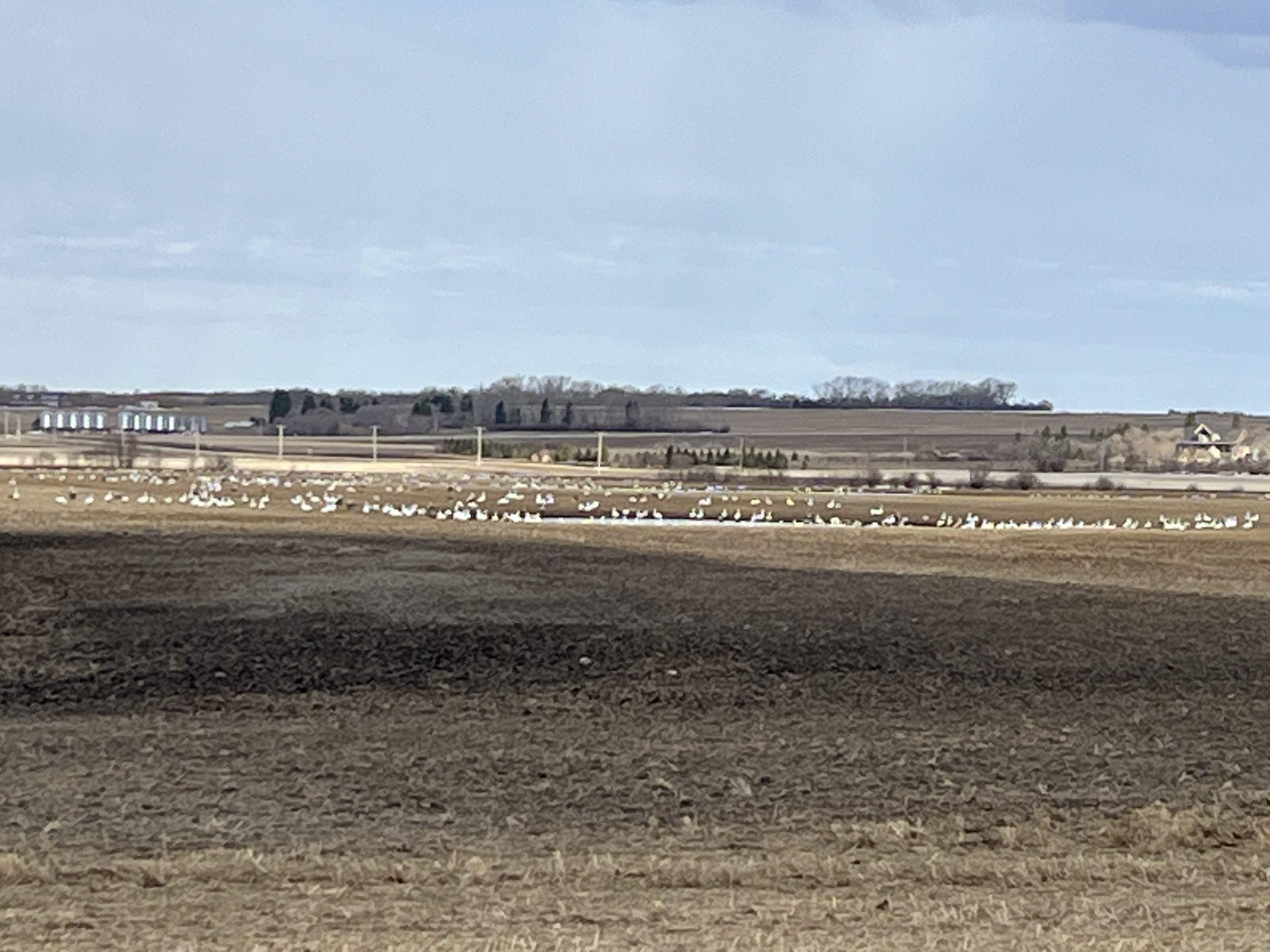
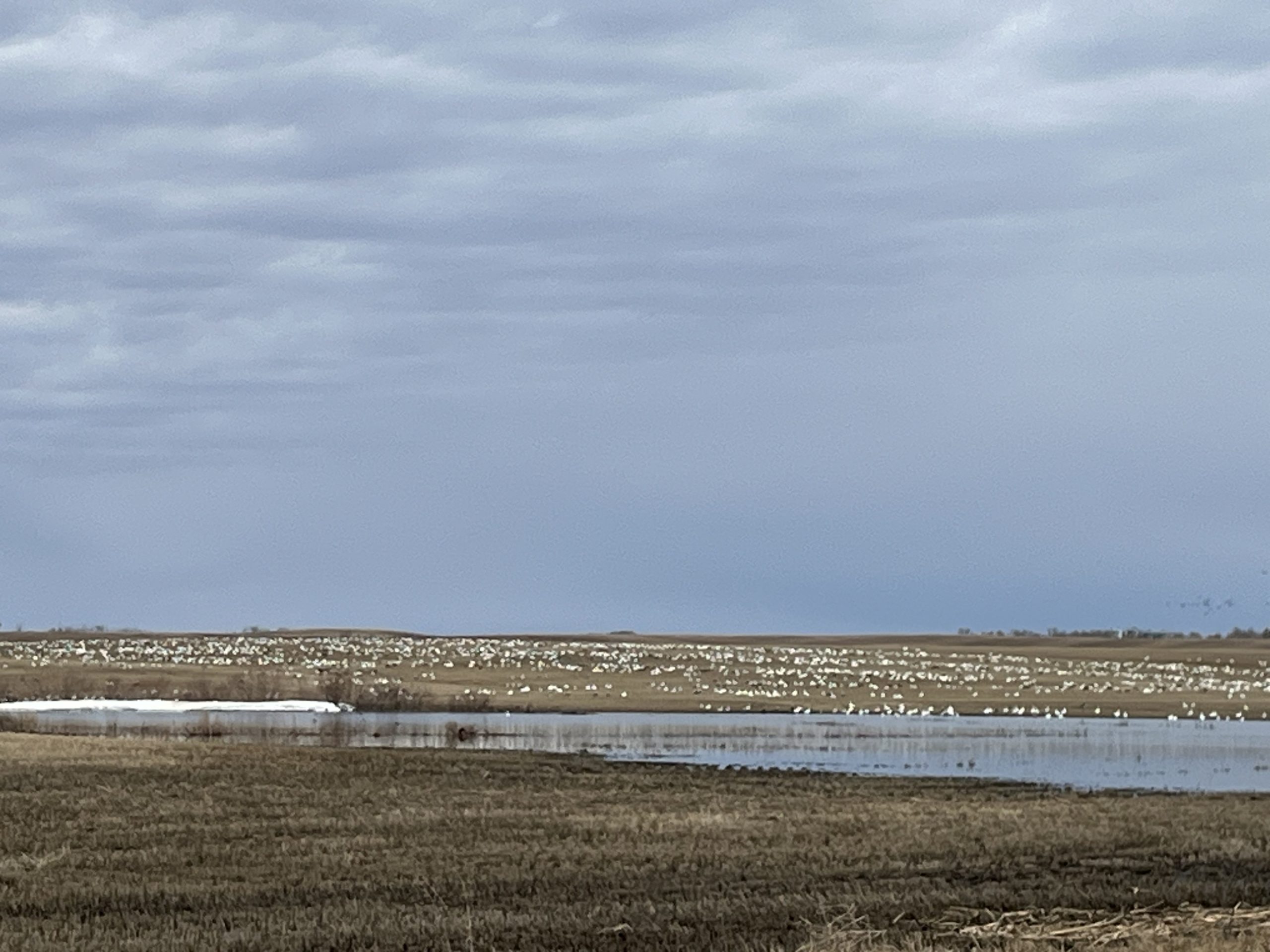
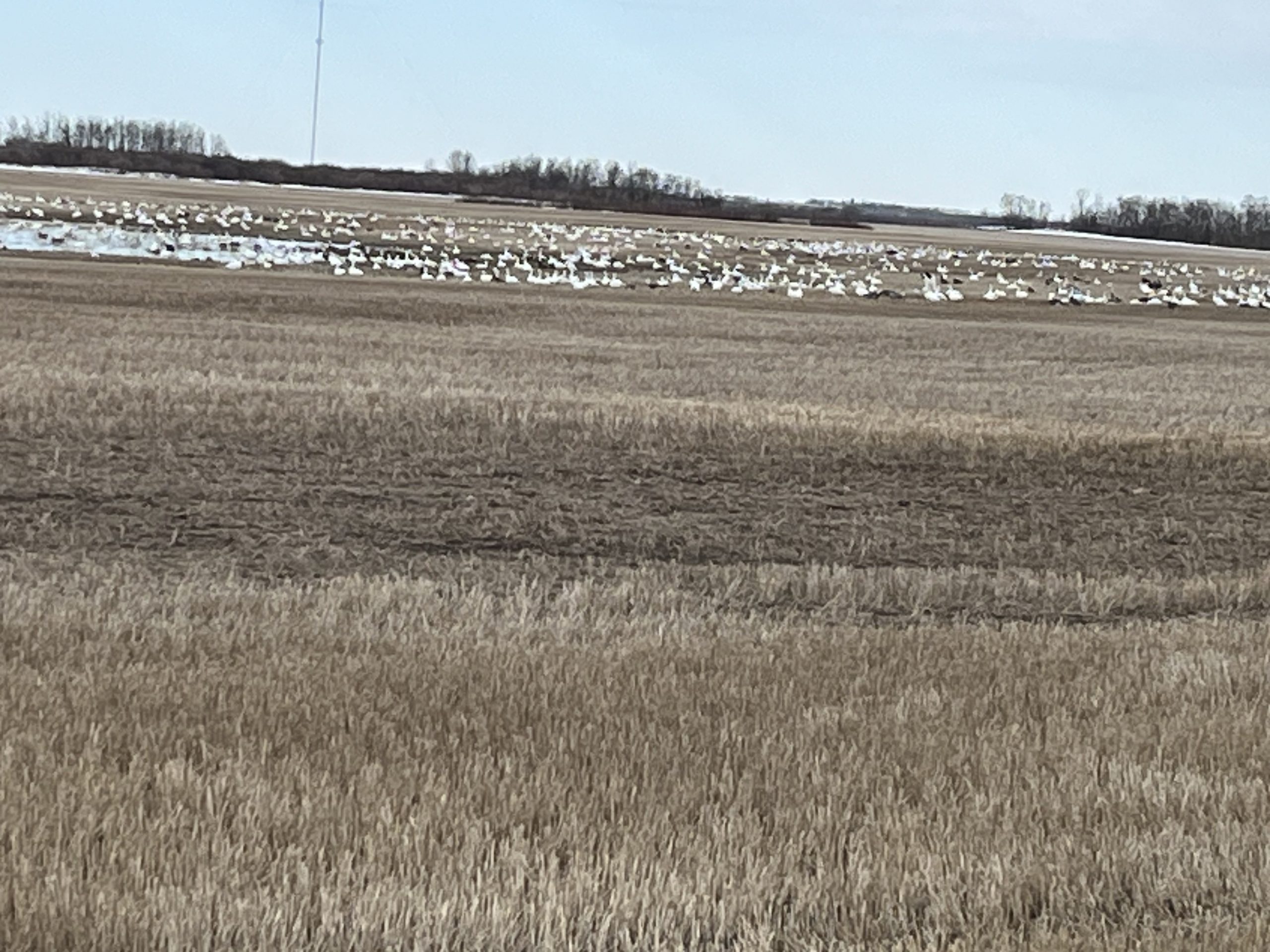
May 2026 compared to October 2025. I have included images from a fall 2025 article and corresponding May 2026 images to provide proof. Below we show the field from October of 2025 and then follow with the same field from May 2026. Note: some pics are from different angles.

Field 1 October 2025

Field 1 May 2026

Field 2 October 2025

Field 2 May 2026

Field 3 October 2025

Field 3 May 2026


Wild animals, such as geese and ducks are creatures of instinct and habit, with a large dose of unpredictability. While spotting, certainly you want to learn the tendencies, the normal actions of the birds you are hunting. But, always be prepared for something to change their routine. While watching one of the fields above this spring, the birds were approached by two coyotes, looking for injured or straggling prey. This caused the entire flock of several thousand birds to jump and move to another field, 1-1/2 miles away.

If you are looking for predictability, what is probably the most consistent in spring hunting is the day water spot. Figure that out and you have the back shoot of your dreams. That’s for another future article.

5 Tips on Scouting for Geese

October 30, 2025 / galen / Goose Hunting, Hunting, Outdoors

I spent a dozen years as head guide for a waterfowl hunting camp in central Saskatchewan. As the spotter, you have sole responsibility for selecting and securing hunting permission for a field where your hunters will set up for the next shoot. During that time I learned a few things about scouting for geese. Some where learned the hard way, by setting up in a field and seeing no birds on approach and others simply from years and years of observation. In most spotting situations, if you have been actively spotting for days and weeks, you will have far greater knowledge and will be able to make a more informed decision. If you are out on a Friday night looking for a Saturday morning shoot, you will have far less knowledge and there is greater risk in the field you pick.

Geese Scouting Tip #1: Timing.

How many days have the birds been in the field? Are you spotting them in the morning or evening spotting? If you have consistently seen geese for a couple days, or at least the morning and evening of the same day, most likely those birds will return to the same field for the following morning and probably the afternoon as well. Morning are more consistent than afternoons. It is after the morning feed that a flock has a chance to pick out other fields and if birds are going to bounce from one field to another, likely that will be the afternoon. If the birds are pushing 3 or 4 days in the same field, they may have reached the limit or ate up most of the grain and will be moving fields soon.

Geese Scouting Tip #2: In-Bound Flock Sizes

Did the birds arrive in 1 flock or many smaller. If you saw the birds arriving at the field, did the flock on the ground build gradually? Ideally you will want a flock that arrives in many smaller groups. As the number of birds in the air increases, so too does the number of eyes looking down at your decoys and blinds. Too many eyes increases the chances of seeing something that sets off the alarms. Small groups arriving over time give you time to shoot and reload while other groups are still far enough away to not be scared off by the sounds of gunfire. A break between groups also gives the dogs a few moments to round up the dead birds on the ground.

Geese Scouting Tip #3: Variety

Are you hunting one species or mixed bag? Are the any ducks in the field? Simply put, more variety equals more certainty of opportunity to shoot. Snow Geese, Canada Geese, ducks, and Specklebellies may all have their own roosts and will fly at different times of the morning or afternoon. Geese will travel long distances from the roost to the feed field while ducks will typically feed closer to the roost so having a good number of ducks in the field increases your chances even if the geese do not cooperate. If there are Snows and dark geese in the field, and one of those species skips your field, you still have chances of a good hunt.

Geese Scouting Tip #4: Location of the Roost

How far away is the roost they came from? If the roost is very close, within one field, sometimes two, then the sounds of gunfire may be close enough to bust the roost and send the geese in another direction. If the wind direction is carrying the sounds of the shotguns away from the roost, then proximity is less and less an issue with the increase in wind speed. If you trace the birds back to a roost a long distance away, and the weather remains consistent between spotting and your next hunt, then that’s a positive. But there is a significant change in weather, such as a large increase in wind or a shift in direction, or rainfall, the geese will be less likely to travel a large distance and will find a feed field closer.

Geese Scouting Tip #5: Young Birds

How many grey snow geese or how many noticeably smaller greater Canadas are in the family groups? A high proportion of young birds is one of the signals of the end of migration approaching and you will want to hunt ’em now before the weather changes. Geese flocks with high numbers of young birds, 25% or higher especially, will hold in place as long as they can, or make short migration hops to give the young birds more time to gain strength for longer flights. However, if you see a high number of these juvenile birds and there is an approaching cold front, expect to see the Snow Geese heading south in the morning, or even after an afternoon feed if the sky is clear and there is good moonlight. One last observation on young birds, they do not have the wisdom of the older birds and will often break off from the flock to check out a decoy spread and can make for some high number shoots later in the migration.

Bonus Material – Field Views

On a couple of recent scouting runs, I took a few images of some fields. Here are a few observations based on the fields. Some of these images where taken with a phone camera on high zoom so the quality is not great.

In the image below, while the total number of geese is only about 1000 (image does not show entire field), there are a good number of young birds. You can see young snows as well as young “Eagle Heads” (blue phase Snow Geese). This could be a good shoot for 3 to 4 hunters.

At first glance, the image below appears to be a small number of dark geese, too few to hunt. But at the back end of the field, you can make out a blotch of white, snow geese.  Watching this field for about 15 minutes I noticed a steady stream of Snows and Canadas landing in the next field, so I went to have a look.

The next field to south was building up with a good number of Canadas.

…and more and more Snow Geese. It’s hard to make out the ducks in the images but there were a few hundred Mallards as well. This could be a decent shoot. I would recommend giving it a another day of observation if you want to hunt a big number of Snow but if you are after Canadas and ducks, its ready.

This is the next morning, the same field as the first image above. Definitely more dark geese and the Snows were about the same spread across the field.

The geese did not gather up in one large group, the were spread out across the field suggesting the field may be approaching being cleaned out so hunt this field soon.

Spring is Here!

March 20, 2019 / galen / Camping, Goose Hunting, Ice Fishing

Welcome to the first day of Spring 2019! After a very cold Winter a warm start to Spring is a very welcome change. Today’s high in Central Saskatchewan is plus 5. Yes, a plus in front of the number. There are signs of spring everywhere. More people out walking, a few Canada geese pairs flying overhead, water running in the streets, fields starting to show under their blanket of snow. Blue skies and sunshine in the forecast. Looks like a great rest of March to come.

More signs of Spring are the provincial campground reservations systems are all available now.

Alberta Campgrounds: https://reserve.albertaparks.ca/
Saskatchewan Campgrounds: https://saskparks.goingtocamp.com/
Manitoba Campgrounds: https://prspub.gov.mb.ca/

Note that not all campgrounds in all parks may be available yet as provinces often stagger the open dates to manage the volume.

It’s officially Spring Snow Goose season, but don’t head out spotting yet. The white geese are still several weeks away. We wont see them until some of the water bodies open up as their push north depends on being able to find both water to roost and food in the fields. I was out ice fishing yesterday, still 3-1/2 feet of ice to auger through so big water is going to be awhile still.

Speaking of ice fishing, March is typically the best month for ice fishing so get out while you can. In most southern zones, ice shacks should have already been removed but that shouldn’t stop you from spending a sunny day drilling holes and catching fish.

Geese in the Air

March 20, 2018 / galen / Goose Hunting, Hunting

It must be spring, there are geese in the air.

Canada Geese March 2018

March 10th at about 2:00 in the afternoon I saw a flock of 25 Greater Canada Geese flying over Saskatoon on their way to the only open water around for a few hundred miles, the river. There were a couple small groups of 3 to 5 birds around as well.

Now if I was a bird, and I could fly, I would still be down south where the fields are bare and the water is warm.

Shoot the 3rd Bird

March 26, 2017 / galen / Duck Hunting, Goose Hunting, Hunting

Spring Snow Goose season is not far away.  Technically the season is already open as of March 15th but the snow geese do not pay attention to the hunting season regulations and they don’t start their journey north to the arctic breeding grounds until there is enough open water and open fields to sustain their multiple thousand bird flocks.  That usually means 2nd to 3rd week of April before we see any good numbers here in Central Saskatchewan.  But with what seems like an early spring this year, we are getting the blinds and decoys organized and guns inspected and oiled.  Oh yeah, stocking up on ammo as well.  Prepping for spring hunting always gets my running through some mental images of what it is like sitting in the blind, watching the geese drop their feet, and then the adrenaline rush at the call of “Take ‘Em! Take ‘Em! Take ‘Em!”.

I’ve had the chance to hunt with few of the most respected waterfowlers in North America.  Snow Goose hunting legends such as Jim Jones and Waterfowl hunting show hosts such as Jared Brown (DU TV), Mike Checkett (DU TV), Buck McNeely (The Outdoorsman), and Chris Dorsey (Orion Media) .  I have also hunted with some great hunters, some great shooters, who aren’t famous but can knock down geese and ducks with anyone.  One thing I have learned is to not try to act like you know everything about hunting when in the presence of the masters.  That doesn’t mean play stupid, it means don’t try to be the expert. Instead, listen, watch and learn.

snow goose flock shooting

We don’t often get this many choices.

A couple of observations come to mind from hunting with Jim Jones and Jared Brown.  It has to do with selection of birds to shoot when there are multiple targets.  Every now and then I like to set the gun aside and take out my video camera.  While doing so I noticed that often when there are multiple bird kills, it’s the close bird that dies last.  Especially with 4 or 5 guns in the blinds, I’ve noticed this to be a trend.

How to Shoot a Triple

To shoot a triple, meaning one hunter kills 3 birds, takes some quick decision making, proper choices, and ultimately excellent shooting.  I have shot a few triples myself, doing it the hard way.  After learning the right way to do it, my multiple bird shoots have increased.  My approach used to be to make sure I got one (like the front end of a double play in baseball) by shooting the easiest to kill bird first then get another by shooting the next and then hoping to drop a third at 80 yards while it’s hightailing it away from the gun blasts.  My success rate on the first bird is pretty good but the second and third attempts drop off quickly.  Part of the issue I like to shoot my old Browning pump shot gun so I am slower to cycle to the second and third shots than when I shoot my Beretta semi-auto.  Don’t ask me to justify that choice.  I guess i just like the pump action and the extra half a second it forces you to prepare for the next shot.

Snow Goose Hunting

Shoot the third bird to shoot a triple.

But now the new method of shooting a triple goose or duck kill.  Start by shooting the third bird closest to you, then shoot the second then the close bird.  On average, the shot length will be shorter, which drastically increases your chances of dropping three birds.  Let’s say you pull on the group of birds when the lead bird is 35 yards out, a comfortable shooting distance for many of us waterfowl hunters.  With normal spacing in a group of birds, the third bird is going to be about 40 to 45 yards out, still a very make able shot, especially if the birds are still in landing mode, wings cupped, feet dragging.  One the first shot, birds flare and try to climb and accelerate away from danger, putting shot number two at about 50 yards, the 40 yards it was at when you shot bird number one, plus 10 yards of get away flight. That should put the final bird at approximately 55 to 60 yards.  Tougher shot, especially when it’s tail feathers may be facing you now, but definitely in killable range.  Contrast this with where the third bird would be, adding roughly 20 to 25 yards to where it was on the first shot, and that puts the last shot at 75 to 80 yards.

A Good Day of Goose Shooting

A Good Day of Goose Shooting

Learning from the Wisdom of Others

Something else I have learned from Jim Jones is the answer to the question how big can a snow goose spread be?  The answer has more to do with the size and capacity of your trailer.  With enough hunters, Jim will empty the trailer meaning there will be up to 1500 decoys on the ground, stretching a few hundred yards.  At first I thought that Jim was insane.  Turns out that might be a little bit true as well, but mostly Jim is cunning.  The monster spread proved it worth that day in Central Saskatchewan as we had 4 snow goose tornadoes over our heads.

Welcome to Spring

March 21, 2017 / galen / Fishing, Fly Fishing, Goose Hunting, Hunting, Ice Fishing

Spring is now officially here.  In reality, the arrival of Spring is highly variable across the prairie Provinces.  Southern Alberta has anglers reaching for their rods and tackle boxes as seasons open up on some of the mountain streams while others will remain closed in May/June.  Make sure you check your regulations for what waters are open.  I have a number of flies and my fly rods at the ready to go join a buddy from Lethbridge and catch some fresh mountain trout in the foothills waters.  As you move further east and north, most lakes are still covered with a health coat of ice but thin ice conditions in some southern zones are dangerous and in need of caution.  I was fishing central Saskatchewan last week and buried the ice auger shaft at one point meaning the ice is still 3-1/2 feet thick.  The later half of March is often the peak of the ice fishing bite.  All the shacks should have been removed by now but portable huts are still usually permitted as long at they are removed when you leave the ice for the day.

Spring also brings the Snow Goose flock control exercises. March 15th is the season opening date in both Alberta and Saskatchewan, although you may not see any huntable flocks of snow geese until mid-April.  Early season flocks of snow geese can be hunted in Alberta often as early as the beginning of April.  Snow geese will rise and fall in latitude with the availability of large open water and food supply.  Because flock sizes are typically in the 10’s of thousands, both of these need to be in large quantity or the birds will simply hold where the food and water is available.  It’s not uncommon for birds to move north, even all the way to central Saskatchewan, then retreat to North Dakota if there is a significant early to mid April snow fall.  Canada geese have been making their presence known in Central Saskatchewan for several weeks already, but in small flocks of 10 or less so open water can be sheet water in a field or a slough edge and food sources only need to support a few beaks, not thousands. of course, only snow geese (including Ross’s Geese) are legal to hunt in the Spring.

Bear seasons don’t open up until mid April so no need to get out the rifles and bows, unless you want to shoot some target practice.

Because of the highly variable conditions, Spring hunting and Spring fishing can be dangerous times of the year.  So get out there, be careful, and enjoy the Prairie Outdoors.

Saskatchewan Goose Hunting

January 26, 2017 / galen / Duck Hunting, Goose Hunting, Hunting

Saskatchewan Goose Hunting is a new web service matching avid Goose hunters to Saskatchewan Goose hunting Outfitters.  The service is 100% Free for Hunters to use.  This new website uses a network of Approved Outfitters who have joined the program and matches them to the hunter’s requirements for number of hunters, dates, as well as other criteria.

See more at SaskatchewanGooseHunting.com

New Survey – Pick Your Shotgun

March 20, 2015 / galen / Goose Hunting

We have just added a new survey on which shotgun gauge you prefer to use when hunting geese. Follow this link to vote for a 12 gauge or a 10 gauge.

12

Recent Posts

  • Game Bird Hunting in Alberta, Saskatchewan and Manitoba: How the Prairie Provinces Compare
  • Big Game Animals of Alberta, Saskatchewan and Manitoba: How the Prairie Provinces Compare
  • Game Birds of the Prairie Provinces: How Manitoba, Saskatchewan and Alberta Compare
  • A Dash of Fall Scenery Images
  • Native Game Fish of Manitoba, Saskatchewan and Alberta: What Makes Each Prairie Province Unique?

Categories

  • Bear Hunting
  • Camping
  • Deer Hunting
  • Duck Hunting
  • Fishing
  • Fly Fishing
  • Goose Hunting
  • Hunting
  • Ice Fishing
  • Life at the Cabin
  • Outdoors
  • Snowmobiling
  • Uncategorized

Subscribe to Updates

Subscribe to our Posts