Prairie Outdoors
  • Email
  • Facebook
  • RSS
  • Home
  • Outdoors Blog
  • Campgrounds and Camping
    • Alberta Campgrounds
    • Saskatchewan Campgrounds
    • Manitoba Campgrounds
    • Camping Photo Contest
    • Country Building Photo Contest
    • Boats and Trailers
    • ATV and Snowmobile Rentals
    • Campground Reservations
  • Hunting
    • Wildlife on Camera 2026
    • Hunting Photo Contest
    • Outfitter Guides and Lodges
    • Buy Hunting Licenses
    • The Campfire
    • Our Favorite Places
    • Know Your Species
    • Saskatchewan Whitetail and Mule Deer Seasons
    • Deer Antler Scoring Whitetail and Mule Deer
    • Scoring Your Black Bear Trophy Skull
    • Moose Antler Trophy Scoring
    • Hunting Dogs
  • Fishing
    • Fishing Photo Contest
    • Buy Fishing Licenses
    • Fishing Camps and Lodges
    • The Campfire
    • Our Favorite Places
    • Ice Fishing
    • Pike & Walleye Weight Chart
  • Outfitters
    • SK Deer Hunting
    • SK Moose Hunting
    • SK Bear Hunting
    • SK Goose Hunting
    • Alberta Outfitters and Guides
    • Saskatchewan Outfitters and Guides
    • Manitoba Outfitters and Guides
    • Trip Finder
  • Hunts For Sale
  • Games
    • Outdoor Hangman
    • Outdoor Trivia
    • Outdoors Trivia 2
    • Survey – Broder Buck vs Hanson Buck
    • Survey – Fishing – Keep or Release
    • Survey – Fishing – Lefty or Righty
    • Survey – Shotgun for Geese
    • Survey – Fishing – Pike vs Walleye
    • Survey – Fly Fishing vs Spincasting
    • Survey – Upland Birds vs Waterfowl Hunting
  • Advertise
    • Advertise Your Outfitter Business
    • Advertise Your Campground
    • Outdoors Web Site Development
    • Sponsor Opportunities on Prairie Outdoors
    • Advertise Your RV Dealership
  • About
Search the site...
  • Home
  • Fishing
  • Fly Fishing (Page 3)

7 Flies For Canada – #2 Brown & White Bucktail

March 28, 2016 / galen / Fly Fishing

Fly #2 in the Series

The bucktail fly is also known as the Mickey Finn. It is intended as a minnow imitation.  I have fished this fly successfully for perch.  They attack it aggressively with their tap-tap-tap bites.  A large size fly, such as a #4 or a #6 is often to big a fly for their small mouths so I like to tie them in #8 sizes as well.

Tying the Brown and White Bucktail

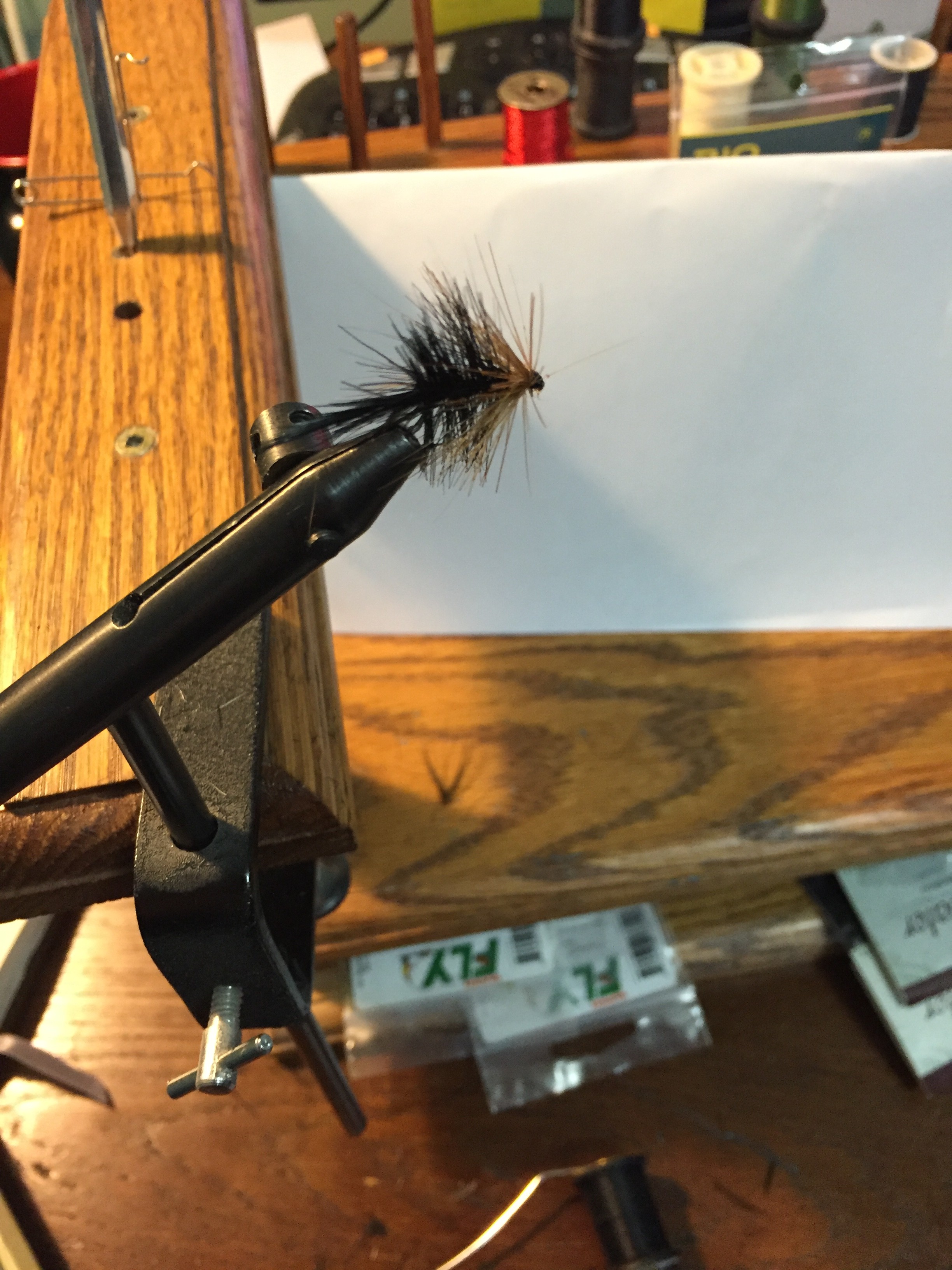
When I dug into my tying supplies, I found myself without the recommended materials for the wing portion of the fly, so, I adapted and used the closest materials I had.  In place of brown and white bucktail, I used long elk body hair and some white or red crystal flash.  Variations of this fly can easily be made by using other colors for the wing and tag sections.

Difficulty level: 3 out of 5.  According to the Fly Tying Bible this is a 3 out 5 for tying difficulty.  I agree with them, if only because of the variety of materials this fly uses.  a 3 out of 5, should mean that the average fly tier should be able to handle it, while a novice may struggle a bit.

Materials:

  • dry fly hooks, from #8 to #4 XL streamer hooks
  • red marabou or red crystal flash for the tag
  • red thread
  • black thread
  • silver tinsel or mylar piping
  • brown and white bucktail strands (I substituted elk hair and crystal flash)

Pinch off the barbs on all your hooks then secure the hook end of one in a vise.  Start the red tying thread about 1/3 back from the eye and wrap the shaft back to the hook bend.  Catch in a small portion of red marabou for the tag.

bucktail-fly-1

Cut a section of silver mylar piping about 2/3 the length of the shaft and remove any stuffing from the inside of the piping.  Slide the piping down the shaft and just past the red tying thread.  Use 5 to 8 wraps of thread to secure the piping in place, whip finish and add some head cement to the red thread.

bucktail-fly-4

Wind on the black tying thread at the eye.  Push the mylar piping in forward then hold in place.  Wind the black thread away from the eye to secure the piping in place.

bucktail-fly-2

brown-and-white-bucktail-fly

Mix together two small bunches of brown and white bucktail and stack one end together.  Place on the shank near the eye and secure in place with several wraps of black thread.  Trim away any excess bucktail reaching past the eye.  Wind on black thread to form a head, whip finish and add head cement to complete.

bucktail-fly-3

Options: You can add weight to the fly with lead wire, either by pre-wrapping the shaft or by attaching the wire at the same time as the piping at the hook bend, then wrapping the wire forward over the piping and securing with the black thread near the eye.  You can also trade the marabou tag for a thread tag made with multiple wraps of built up thread.

bucktail-fly-5

When tying a shorter shaft fly, the mylar piping can be difficult to work with in such short lengths.  Substitute some silver tinsel, using overlapping wraps from the hook bend to the black thread just behind the eye.

bucktail-fly-6

The Fly Box:

IMG_6528


7 Flies For Canada – #1 Bead Head Wooley Bugger

March 14, 2016 / galen / Fly Fishing

Fly #1 in the Series

Tying the Bead Head Wooley Bugger

Difficulty Level: 2 out of 5.
All of the steps are pretty basic, but if you decide to add your own enhancements and options it becomes a little more challenging. The most difficult step is winding the hackle, but get yourself some good hackle pliers and it will be an easy job.  According to the Fly Tying Bible (you need this book if you are even thinking of ever tying a fly) this is a 3 out 5 for tying difficulty.

Materials:

  • #4 Streamer Hook
  • Brass or Copper Bead Head
  • Lead Wire (optional)
  • Black Thread
  • Black/Olive Strung Marabou
  • Black/Olive Hackle
  • Black/Olive Chenille
  • Red Floss (optional)

Start by pinching down the barb on the hook with a set of pliers.

wolley-bugger-fly-2

Slide the bead head over the hook and forward to the eye of the hook

(Optional) Wind the Lead Wire from the bend of the hook forward to the eye.

wolley-bugger-fly-3

Wrap the thread approximately 5 times just behind the lead wire at the hook bend and catch in a bunch of marabou, stem of the hackle, and the Chenille.  Continue winding the thread forward to the eye, which also serves to secure the lead wire in place.

wolley-bugger-fly-4

Wrap the chenille forward to just short of the bead head and catch in place with several wraps of thread.

wolley-bugger-fly-5

Wind the hackle forward and catch in place with thread behind the bead head.  Tie off the thread and add head cement to finish the fly.

wolley-bugger-fly-6

Options: You can create variations of this fly very easily, just by changing the color scheme of the fly, substituting olive for black in any of the material, from all olive to all black, and a mix of colors in between.  On an all black version, create an egg-sucking leach by skipping the bead head and using red floss to build up a red, egg shaped portion just behind the hook eye.

wolley-bugger-fly-12

wolley-bugger-fly-14

The Fly Box:

IMG_6529

7 Flies That Catch Fish in Canada

March 11, 2016 / galen / Fishing, Fly Fishing

I recently read an article in Outdoor Canada Magazine (my second favorite outdoor magazine) titled 7 Easy to Tie Flies That Will Catch Fish Anywhere in Canada. I live “Anywhere in Canada” and I love to fly fish so I have decided that it is my mission this summer to try all these flies and give you a report on how well they work and how easy to tie they are. One of the points the author makes is “these flies will work just fine if they’re a little sloppy”. Coincidentally that’s exactly how I tie most of my flies. I think “sloppy” also makes them look “buggy”, and, in some cases, injured.
So, the 7 flies are (in order of the images below the list):

  • BEAD-HEAD WOOLLY BUGGER
  • BROWN & WHITE BUCKTAIL
  • CLOUSER DEEP MINNOW
  • BIVISIBLE
  • HARE’S EAR FLYMPH
  • X-CADDIS
  • EGG FLY

bead-head-wooley-buggerbrown-and-white-bucktail clouser-deep-minnowbivisiblex-caddishares-ear-nymphyellow-egg-fly

I have tied and fished flies similar to all these at some point, except maybe the BiVisible.  Good news, I can remember catching fish on all of them, from walleye and goldeneye on the Clouser Minnow to rainbow trout on the caddis.  The wooley bugger has been a favorite, catching a wide variety of species including pike, walleye, and rainbow trout.  The bucktail has work especially well on perch.  I haven’t used an egg fly pattern in Canada, but I have caught steelhead on the Salmon river in Idaho with an orange/red version.  Hare’s ear nymphs have caught rainbow trout and perch.

By the end of summer, I will also add a few of my favorites to the list, hopefully arriving at a respectable 10 flies that are easy to tie, easy to fish, and catch fish.  Expect that list to include the Super Jumbo Mosquito.

jumbo-mosquito-fly-12

Summer Fishing Plan

My plan for the summer is fill a new fly box with only these flies and fish them as often as I can.  Translation: I now have another reason to go fishing.  Whenever I convert my gear fishing fishing buddies over the art of fly fishing, I will arm them with a few of these flies and keep track of how well they do.  Well, 2 months until fishing season opens, I’d better get tying some flies.

new-fly-boxopen-fly-box

Sunset Trout – Advice on Trout Fishing

August 11, 2015 / galen / Fishing, Fly Fishing

Fly fishing for trout is a roller coaster experience.  When you find the right time and the right tackle, it’s pure adrenaline.  Acrobatic splashes, long runs, and a beautiful fish on the end of the line.  When the bite is off, the bite is off.  Trout tend to be very finicky, so if you find something that works, stick to it.  I have found the combination that has worked wonders for the past two weeks.

While fly fishing my favorite trout pond, I try to experiment and see what happens with a different pattern of fly, fished on the bottom, pulled just below the surface, fast and slow, drifting, changing colors and sizes of the same or different flies, and changing location of my casts.  While the old adage, “match the hatch” is certainly true, I’ve stumbled across a magic combination for catching trout at sunset in the middle of August.  The key to the whole matter may be the time of day, but here’s what’s worked for me.

I started fly fishing that evening at about 7:00 pm, casting and switching flies frequently, hoping to catch a few nice rainbows before it got dark.  There was a lot of action near the surface, but little for bugs on the top of the water.  My guess was they were feeding just below the surface.  So I changed tactics, tied on a dry and went for a fast retrieve just below.  The result, a few nibbles, even a couple of little ‘bows too small to really count as a fish.  So I changed flies, larger and smaller.  Retrieved faster and slower and deeper and left and right, and the same results, occasional nibbles.  The sun was quickly dropping behind the hill over my right shoulder, and the top water action was starting to die down.  Disappointed, I gathered in my line and began the short walk from the far end of the pond to where I had parked my truck.

It was 8:30 now and would soon be getting difficult to see.  In the 2 or 3 minutes it took to walk the length of the pond, the action suddenly increased, and the rises appeared larger than before!  I paused!  I thought! I took my rod back out of the case and cast my fly about 30 feet out.  Fish on!  A quick release and another cast.  Fish on!  That was two fish (and these could legitimately be called fish) in 1-1/2 minutes when I had caught next to nothing in the past 1-1/2 hours.  So I continued casting and catching, as the sun disappeared and I could no longer see my line, but I kept catching trout, and they seemed to be increasing with size as it got darker.  So I thought to myself, I’m staying here until I tangle or I lose my fly.  By the time I finally did tangle, it was 9:45 pm and the stars were shining bright.  I was the last to leave the pond that night.  Most others had left as the sun was setting and missed all the real activity.

Not sure if this was a one time phenomenon, I was determined to test my theory the next night as well, as all good scientists will do.  An experiment which can be replicated has no validity.  Therefore, in the interests of science (trout fishing research), I was duty bound to return, Tuesday, Thursday, the following Monday, Tuesday and again Thursday.  Each night, the results were the same.  A few nibbles, a few trout landed, then just after sunset, success every second or third cast.  My belief is that the trout were not so much going after a particular pattern of fly but more on the movement of the fly.  The first three nights I tried not to vary the experiment too much, sticking with a pheasant tail nymph each night and using a rapid retrieve just below the surface.  Most of the hits came within the first couple of pulls on the line, some the instant the fly hit the water.  I did move around the pond, trying shallow and deeper waters, close to and directly away from shore.  It didn’t seem to matter, the bite was on everywhere!

This past Monday I decided to try a different pond, one I know holds larger fish.  The results were very similar.  These last two days I varied the pattern, switching from the pheasant tail nymph to a zug bug to an imitation shrimp.  All three patterns about equal in size but varying in color.  It didn’t seem to matter.  All flies were equally successful.  I’ll be returning tomorrow night, well prepared, and experimenting again with a few different fly patterns.

Here’s my advice for fly fishing when the light is starting to diminish.  First of all, bring a small flash light.  The light will come in handy when you snag your cast, when you tangle your line, when you want to tie on a different fly, and especially when releasing a fish which has taken the fly deep in it’s mouth.  As always, it’s easier to release the fish with a barbless hook, or with the hook pinched down.  Shorten up your line.  You won’t need a lot of line, the fish are as active 10 feet off shore as they are 50 feet off shore.  A shorter line leaves less chance of tangling in the dark.  A side benefit of casting in the dark is you really learn to cast by feel and get into the rhythm of the cast.  The only senses you have are touch, taste, sound, and smell, and three of those don’t help much.

Man vs Mosquito

July 14, 2015 / galen / Fishing, Fly Fishing

Today I attempted to fish at the North American mosquito testing grounds. I pulled up and parked near one of my favorite fishing spots and opened the door to get out. Within 2 seconds I had two mosquitoes on my ear. Like a fight in a high school parking lot, it was on! Out came the Muskol. I was determined to not let a pesky little insect prevent me from casting my fly rod and hooking some trout, maybe that big brown I’ve seen feeding on the surface nearby. In fact, mosquitoes be damned, I will use them to my advantage.

I defiantly walked to the waters edge and tied on my “Jumbo Mosquito” pattern and started casting, through a cloud of mosquitoes, so it seemed. Every piece of exposed skin was covered, twice, with bug repellant, but they were all over me. I set my rod down and started applying bug repellant directly onto my clothes. I read the label, “Apply sparingly, re-apply as needed, lasts up to 6 hours”. Try 6 minutes and only when applied in thick layers. It was better to be on the move. With myself and my dog constantly moving and casting, I thought I could move away from the swarm, only to realize I was moving into the next swarm. Walking through the grass only bounced more mosquitoes into the air.

I was convinced I was in a battle with Muskol resistant mosquitoes, or these are the mosquitoes from the bad side of town and they treat Muskol like candy or a cheap drug. The more I put on, the more I was swatting at mosquitoes landing on my neck, arms, legs. Finally after an hour and a half, and no fish, I packed it in and headed home. I saw the big brown trout surface again. I’ll be back for him, with uber strength bug repellant. Perhaps a double layer of Muskol Extra Heavy Duty and Deeper Than Deep Woods Off.

This round to the mosquitoes. Next round to man!

Your Rod as a Fish Ruler

July 3, 2015 / galen / Fly Fishing

When you are busy fishing, you have a hand full of rod, reel and line, and hopefully a net in the other, ready to land your latest catch. Once you remove the hook, do you have time to fumble through your vest for a ruler to measure the fish, getting it back to the water quickly? What if your rod was also your ruler?

I have 3 fly rods, an 8 weight I use for pike, a 6 weight for river fishing, and a 4 weight for trout ponds and perch. Recently I was fishing a trout pond and tied into a decent fish for the pond, about 12 inches, but not exactly sure.  I laid the fish down beside my 4 weight rod and reel for a quick photo then slipped the fish back into the water.

JulyRainbowTrout1

It looks like about 12 inches.  A few years ago, I had used thin strips of duct tape wrapped around the shaft of my 6 weight rod to mark off ruler lengths of 12 inches and then every 3 inches.  When I took the above picture, I realized my 4 weight rod doesn’t have the ruler markings, so I used some colored electrical tape and added the measurements to my 4 weight, my 8 weight, and redid the markings on my 6 weight.

RodsAsRulers4

Some might say the color tape makes the rods look a little ugly, but I don’t mind, and the quick ruler is a time saver on the water.  I don’t bother with longer measurements on the 4 weight, I have it marked at 12″, 15″, and 18″.  I don’t expect to catch anything bigger than that with that rod.  The 6 weight goes up to 27″ which would be one hell of a trout.  The 8 weight is marked from 12″ all the way up to 48″, because I’m an optimist.

RodsAsRulers5

Tying the Super Jumbo Mosquito Fly

June 29, 2015 / galen / Fly Fishing

I have fished the Jumbo MosquitoTM fly a number of times over the past few years and it is the best trout pond fly I have ever used.  The only negative I can state is that the fly is not very durable.  After a few fish landings and especially when the forceps are needed to remove a fly from a trout, the fly gets beat up and starts to unravel.

Because the fly is so easy and inexpensive to tie, I have always compensated by tying lots of them and switching flies when this happens.  That is, until I came up with the Super Jumbo MosquitoTM fly.  A slight modification has made the fly more durable, and takes a minimal amount of additional effort.

Fly Tying Materials:

Same materials as the Jumbo Mosquito:

  • #14 dry fly hook
  • Black thread
  • Peacock Hurl
  • Head Cement

I could use a smaller hook, I have, but #14 seems to be the size the trout like.

jumbo-mosquito-fly-04Tying the Fly:

Step 1:  Place your hook in the vise and wind your thread on to the start of the hook bend.  I like to catch the bottom half of the hook bend with my vise so that I can wind the thread further back.

jumbo-mosquito-fly-08

Step 2: Pull off two stands of the the peacock hurl.  I found this particular peacock feather lying on the ground at the local zoo.  Trim off any excess material that may have pulled off the stalk of the feather.  Then catch the peacock hurl in place with a few wraps of thread.  Leave the thread at the hook bend.

jumbo-mosquito-fly-07

super-jumbo-mosquito-fly-15

Step 3: Wind the peacock hurl towards the eye in tight wraps, touching the previous wrap.  Once you reach the eye of the hook, place a hackle pliers on the peacock hurl to hold them in place and free up both hands.

super-jumbo-mosquito-fly-16

Step 4: Wind the black thread over the peacock to the eye.  This gives the fly the added durability, keeping the peacock fibers from breaking and unraveling.

super-jumbo-mosquito-fly-17

Step 5: Trim off the excess peacock, build a small head with a few more wraps.  Perform a whip finish and put a drop of cement on the head.

jumbo-mosquito-fly-11

The finished fly:

The picture below has the Jumbo MosquitoTM fly in the center, and four Super Jumbo MosquitoTM flies around it.  The Super Jumbo MosquitosTM are slightly thinner, but have proven to catch just as many fish, and far more durable.

jumbo-mosquito-fly-18

How to Fish this Fly:

Anytime trout are feeding on small top water bugs, this fly works.  Especially if a mosquito hatch is underway.  Because I fish it on trout ponds (still water = mosquito breeding ground), I can be pretty sure there are mosquitoes around from mid May to mid September.

You can toss the fly randomly, hoping to catch the eye of a fish looking to the surface.  I’ll do that until I see a fish rise, then I’ll quickly lay the fly in the middle of the ripple.  A couple quick short pulls will get the attention of the fish feeding there.  If not, move the fly to another spot.  Sometimes I will catch a fish after pulling the Super Jumbo MosquitoTM for 10 or 20 feet but most hits are within 2 feet of where it lands.

Tying the Jumbo Mosquito Fly

June 18, 2015 / galen / Fly Fishing

What’s the world’s best fly?  I would argue the Jumbo Mosquito.  My criteria is simple, the fly with the highest fish caught to tying time ratio.  I sat down today to tie some Jumbo Mosquito flies, 5 of them, for tonight’s outing to the local trout pond.  5 flies, plus the time to take a few pictures, total time = 15 minutes.  Last night I used up 3 Jumbo Mosquito flies, while catching 29 trout.

I don’t know if anyone else has already invented and named a fly like the Jumbo Mosquito.  If not, I am putting a Trade Mark on it right now.  The Jumbo MosquitoTM.  There, done.  This fly is so easy to tie that even if it is your first fly ever tied, it will work for you.  I think the most expensive item on the materials list are the hooks.

Here’s my fly tying desk, complete with the Fly Tying Bible.  It’s not in there, but I recommend the book.  Great stuff in there.

jumbo-mosquito-fly-01Fly Tying Materials:

What I use:

  • #14 dry fly hook
  • Black thread
  • Peacock Hurl
  • Head Cement

I could use a smaller hook, I have, but #14 seems to be the size the trout like.

jumbo-mosquito-fly-04Tying the Fly:

Step 1:  Place your hook in the vise and wind your thread on to the start of the hook bend.  I like to catch the bottom half of the hook bend with my vise so that I can wind the thread further back.

jumbo-mosquito-fly-08

Step 2: Pull off two stands of the the peacock hurl.  I found this particular peacock feather lying on the ground at the local zoo.  Trim off any excess material that may have pulled off the stalk of the feather.  Then catch the peacock hurl in place with a few wraps of thread.  Continue the thread to the head.

jumbo-mosquito-fly-07  jumbo-mosquito-fly-09

Step 3: Wind the peacock hurl towards the eye in tight wraps, touching the previous wrap.  Then hold the peacock in place with a couple wraps of thread.

jumbo-mosquito-fly-10

Step 4: Trim off the excess peacock, build a small head with a few more wraps.  Perform a whip finish and put a drop of cement on the head.

jumbo-mosquito-fly-11

The finished fly:

jumbo-mosquito-fly-12

How to Fish this Fly:

Anytime trout are feeding on small top water bugs, this fly works.  Especially if a mosquito hatch is underway.  Because I fish it on trout ponds (still water = mosquito breeding ground), I can be pretty sure there are mosquitoes around from mid May to mid September.

You can toss the fly randomly, hoping to catch the eye of a fish looking to the surface.  I’ll do that until I see a fish rise, then I’ll quickly lay the fly in the middle of the ripple.  A couple quick short pulls will get the attention of the fish feeding there.  If not, move the fly to another spot.  Sometimes I will catch a fish after pulling the Jumbo MosquitoTM for 10 or 20 feet but most hits are within 2 feet of where it lands.

Bow River Trout – Fly Fishing Tips

May 19, 2015 / galen / Fishing, Fly Fishing

I’ve read a lot of fly fishing tips but living in Saskatoon does not afford one the opportunity to fly fish a river for trout very frequently.  Never having done so, I didn’t think I was missing much.  After all, there are plenty of ponds and small lakes stocked with trout within a couple hours drive of Saskatoon.  But, as I was delighted to find out, there’s a big difference between a trout laying at the bottom of still water and a trout spending it’s life in a river moving 15 miles per hour.  Wild trout vs. stocked trout?  I’ll take the wild trout please.

I was fortunate to be fishing with someone who has fished the bow river many times and knows how to read the water for good fish holding areas.  In fact, as my brother in law Terry was demonstrating how to cast the double nymph rig, he immediately hooked a fish.  A small rainbow was sent back to grow bigger.  Now I was pumped!  Standing in the Bow River, fly fishing, one fish already caught, but not by me, yet.  I decided to follow his fly fishing tips as I awkwardly cast the stone fly and san juan worm into the seam between the fast water and the slow water just in front of me, and let it drift through a pool.  After three or four tries, I got one “not too bad” according to Terry and suddenly the strike indicator was gone.  I set the hook with a quick tug and “FISH ON!”.  Being a novice to river fishing, I gave it too much and it took off cross-river, got behind a rock, and worked it’s way free of the hook.  thinking we may have “spooked the hole”, we waded down stream 25 or 30 steps to a spot Terry called a “classic nymph run”.  I worked the nymph rig into place with a couple of casts and drifted through the hole, poorly, the first four times.  On the fifth try, a decent cast, a decent mend to the line, and the strike indicator disappears again.  I set the hook, the fish takes off.  Terry not too gently instructs me to turn the fish to the bank.  I manage to do this, while noticing the pull on the line and the bend in my 9 foot 6 weight fly rod is nearly 90 degrees.  This one feels like the “Bow River ‘bows” I’ve heard about!  It takes off, down stream, a strong fish with the current and my reel makes that beautiful ZIIIIIIIIINNNNNG sound of a good fight.  On aerial display number of 4, we can see it’s a good sized fish.  After a 3 or 4 minute battle, we have the fish in hand (see the pictures in the Campfire).  My first fish landed on the Bow River is an 18″ Rainbow Trout.  I was feeling pretty good about it, especially as we released it back into the river.

The gear we were using was a 9 foot, 6 weight rod, floating line, 9 feet of leader with a strike indicator, 2 feet of 4x tippet tied to a San Juan worm with an extra 18″ of 4x tippet tied to the hook on the San Juan and then to a stone fly nymph.  “Why the two flies?”, I asked Terry.  “Because the rainbows like the stoneflys and the browns like the worms he explained.  I couldn’t argue, and for good reason.  We moved another 25 to 30 feet down stream and I worked the rig through a similar seam and a few good drifts later had hooked into a big brown.  It took off right away and I could feel the power of this fish.  5 minutes later, we discovered the 20” brown trout had taken the San Juan worm.

What I learned was that fishing a nymph rig was al about getting the right float.  If you don’t pass through the hole looking like the way the food usually does, you get ignored.  Get the right float, and your chances improve.  With the fast moving water of the Bow River, a bad float might last 5 seconds, and your flies may never get in the right place, down low, into the pools that hold the fish.  This is usually caused by too much fly line laying on the water ahead of the strike indicator.  A good cast, about 45 degrees from the bank, and a slight mend to the line, seems to double the time the flies are drifting, getting deeper, acting like food.  On all of my bad casts/mends/floats I caught no fish at all.  That’s one big difference between river fishing and lake fishing, technique really matters.  You don’t need to cast very far to catch the fish only 10 feet in front of you, but you need to use good technique.  On a lake, many a bad cast have produced fish for me.  In fact, I’ve hit the water on my back cast before when fly fishing for Pike and accidentally caught a fish, on the back cast.  On the Bow River, it’s all about getting the right float.

We have more fly fishing tips in the journal. We encourage you to read them and add you comments.

We hope this story will help you land more fish the next time you go rainbow trout fly fishing or brown trout fly fishing. Keep the fly fishing tips from this story in mind.


How Do You Fish?

May 8, 2015 / galen / Fishing, Fly Fishing

Some people fish with a spin cast rod and reel while others will take up nothing by a fly rod.  How about you?  Do you Fly Fish or Spincast?

Take the survey and make your opinion known.

1234

Recent Posts

  • First Fishing Trip of the Season
  • A Lesson in Remote Boat Repairs – Bring Extra Parts
  • A Sea-Doo Makes a Terrible Kayak
  • Putting Out the Dock and Lift – High Water
  • Spring Time is Work Time

Categories

  • Bear Hunting
  • Camping
  • Deer Hunting
  • Duck Hunting
  • Fishing
  • Fly Fishing
  • Goose Hunting
  • Hunting
  • Ice Fishing
  • Life at the Cabin
  • Outdoors
  • Snowmobiling
  • Uncategorized

Subscribe to Updates

Subscribe to our Posts