Prairie Outdoors
  • Email
  • Facebook
  • RSS
  • Home
  • Outdoors Blog
  • Campgrounds and Camping
    • Alberta Campgrounds
    • Saskatchewan Campgrounds
    • Manitoba Campgrounds
    • Camping Photo Contest
    • Country Building Photo Contest
    • Boats and Trailers
    • ATV and Snowmobile Rentals
    • Campground Reservations
  • Hunting
    • Wildlife on Camera 2026
    • Hunting Photo Contest
    • Outfitter Guides and Lodges
    • Buy Hunting Licenses
    • The Campfire
    • Our Favorite Places
    • Know Your Species
    • Saskatchewan Whitetail and Mule Deer Seasons
    • Deer Antler Scoring Whitetail and Mule Deer
    • Scoring Your Black Bear Trophy Skull
    • Moose Antler Trophy Scoring
    • Hunting Dogs
  • Fishing
    • Fishing Photo Contest
    • Buy Fishing Licenses
    • Fishing Camps and Lodges
    • The Campfire
    • Our Favorite Places
    • Ice Fishing
    • Pike & Walleye Weight Chart
  • Outfitters
    • SK Deer Hunting
    • SK Moose Hunting
    • SK Bear Hunting
    • SK Goose Hunting
    • Alberta Outfitters and Guides
    • Saskatchewan Outfitters and Guides
    • Manitoba Outfitters and Guides
    • Trip Finder
  • Hunts For Sale
  • Games
    • Outdoor Hangman
    • Outdoor Trivia
    • Outdoors Trivia 2
    • Survey – Broder Buck vs Hanson Buck
    • Survey – Fishing – Keep or Release
    • Survey – Fishing – Lefty or Righty
    • Survey – Shotgun for Geese
    • Survey – Fishing – Pike vs Walleye
    • Survey – Fly Fishing vs Spincasting
    • Survey – Upland Birds vs Waterfowl Hunting
  • Advertise
    • Advertise Your Outfitter Business
    • Advertise Your Campground
    • Outdoors Web Site Development
    • Sponsor Opportunities on Prairie Outdoors
    • Advertise Your RV Dealership
  • About
Search the site...
  • Home
  • Articles posted by galen (Page 9)

The Guy Trip

June 30, 2015 / galen / Fishing

It’s almost a year since the last guy only fishing trip. I don’t know why I call it that. It’s always all guys I don’t think that women are invited. A bunch of us get together, usually at the start of May and go to catch some rainbows on a fly rod.

The planning doesn’t take long. Pick a weekend, buy some food, beverages, and pack a minimum amount of clothing, lots of fishing stuff and worry about the sleeping arrangements when we get there. It’s a simple, uncomplicated process.

The guy trip must be a fascinating thing to women. I am in no way a chauvinistic person, but I can’t see my wife or any of our wives picking a weekend and just going to do nothing but be there. With a girl trip, its all about what are they going to do, where are they going, what are they going to wear, what are they going to see and so on and so on.

We go on this trip to drink, eat, fish and sleep and that’s about it and not necessarily in that order. We can go for hours and not talk, we can laugh at things that our wives would kill us if they ever found out what we were talking about, and most importantly we can be ourselves. There is no one there to impress, no one to criticize, always some one to make fun of and it’s all in good fun.

The trip is about more than just catching fish. It’s about friends, family, fun times and connecting in a very surreal way with nature. Its about bragging rights that last 5 minutes or 5 hours. Its about spending time with people that don’t care if you’ve had a shower brushed your hair or how you look. Within every trip there are lessons learned in life, fishing and family. That’s what the trip is about. It’s a simple, uncomplicated, fun, fantastic time. Everyone should do it. If you do it once, you’ll do it forever.

Tying the Super Jumbo Mosquito Fly

June 29, 2015 / galen / Fly Fishing

I have fished the Jumbo MosquitoTM fly a number of times over the past few years and it is the best trout pond fly I have ever used.  The only negative I can state is that the fly is not very durable.  After a few fish landings and especially when the forceps are needed to remove a fly from a trout, the fly gets beat up and starts to unravel.

Because the fly is so easy and inexpensive to tie, I have always compensated by tying lots of them and switching flies when this happens.  That is, until I came up with the Super Jumbo MosquitoTM fly.  A slight modification has made the fly more durable, and takes a minimal amount of additional effort.

Fly Tying Materials:

Same materials as the Jumbo Mosquito:

  • #14 dry fly hook
  • Black thread
  • Peacock Hurl
  • Head Cement

I could use a smaller hook, I have, but #14 seems to be the size the trout like.

jumbo-mosquito-fly-04Tying the Fly:

Step 1:  Place your hook in the vise and wind your thread on to the start of the hook bend.  I like to catch the bottom half of the hook bend with my vise so that I can wind the thread further back.

jumbo-mosquito-fly-08

Step 2: Pull off two stands of the the peacock hurl.  I found this particular peacock feather lying on the ground at the local zoo.  Trim off any excess material that may have pulled off the stalk of the feather.  Then catch the peacock hurl in place with a few wraps of thread.  Leave the thread at the hook bend.

jumbo-mosquito-fly-07

super-jumbo-mosquito-fly-15

Step 3: Wind the peacock hurl towards the eye in tight wraps, touching the previous wrap.  Once you reach the eye of the hook, place a hackle pliers on the peacock hurl to hold them in place and free up both hands.

super-jumbo-mosquito-fly-16

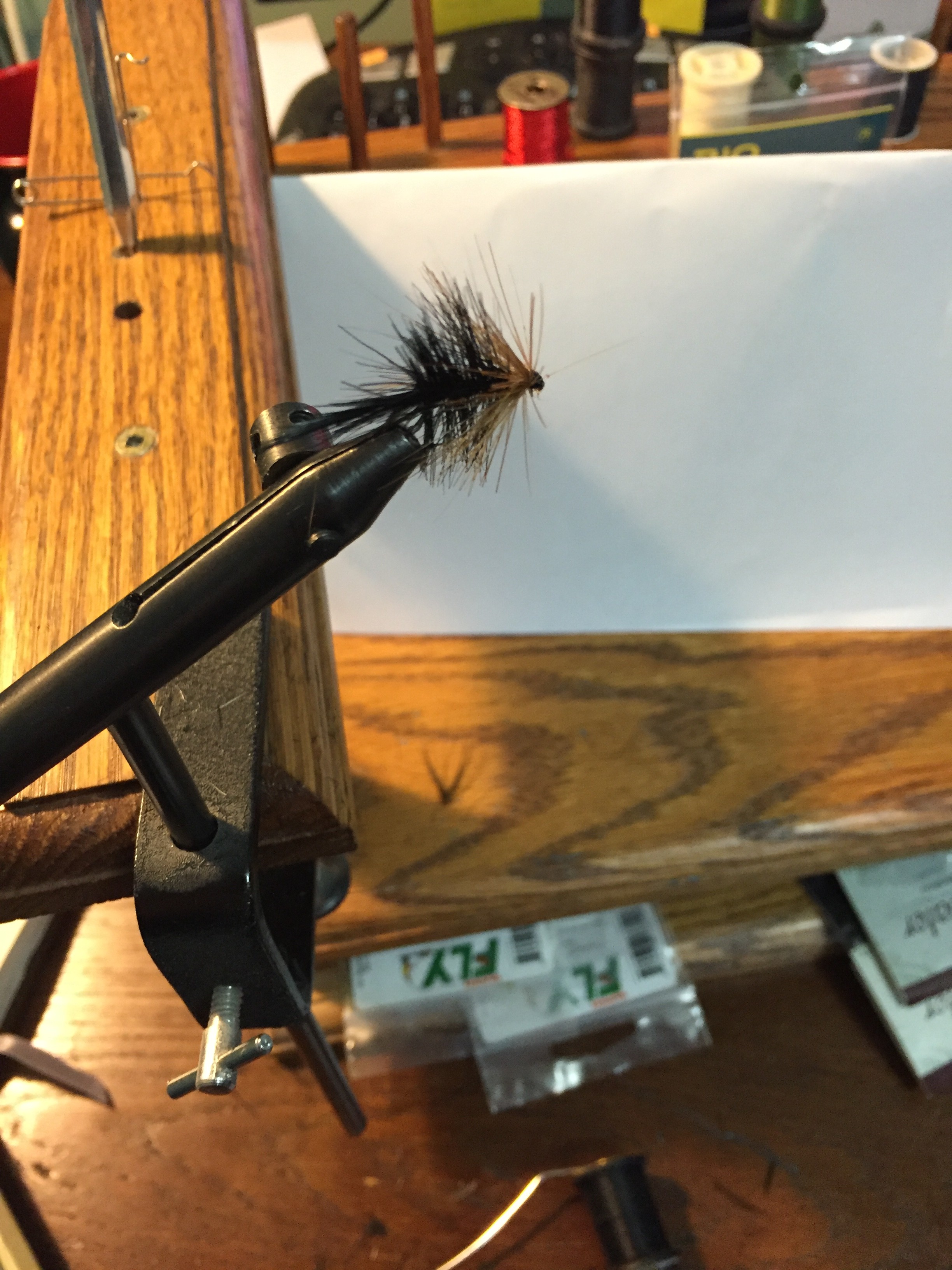
Step 4: Wind the black thread over the peacock to the eye.  This gives the fly the added durability, keeping the peacock fibers from breaking and unraveling.

super-jumbo-mosquito-fly-17

Step 5: Trim off the excess peacock, build a small head with a few more wraps.  Perform a whip finish and put a drop of cement on the head.

jumbo-mosquito-fly-11

The finished fly:

The picture below has the Jumbo MosquitoTM fly in the center, and four Super Jumbo MosquitoTM flies around it.  The Super Jumbo MosquitosTM are slightly thinner, but have proven to catch just as many fish, and far more durable.

jumbo-mosquito-fly-18

How to Fish this Fly:

Anytime trout are feeding on small top water bugs, this fly works.  Especially if a mosquito hatch is underway.  Because I fish it on trout ponds (still water = mosquito breeding ground), I can be pretty sure there are mosquitoes around from mid May to mid September.

You can toss the fly randomly, hoping to catch the eye of a fish looking to the surface.  I’ll do that until I see a fish rise, then I’ll quickly lay the fly in the middle of the ripple.  A couple quick short pulls will get the attention of the fish feeding there.  If not, move the fly to another spot.  Sometimes I will catch a fish after pulling the Super Jumbo MosquitoTM for 10 or 20 feet but most hits are within 2 feet of where it lands.

Bear Down Outfitters

June 19, 2015 / galen / Bear Hunting, Hunting

Announcing our newest Premium Outfitter, Bear Down Outfitters.

Our parent company, Netnotic Marketing, has just launched a website for a new outfitter, www.beardownoutfitters.com.  They are located at the north end of Brabant Lake, in Northern Saskatchewan.

We could tell you all about them here, but that’s what we built them a website for.

Tying the Jumbo Mosquito Fly

June 18, 2015 / galen / Fly Fishing

What’s the world’s best fly?  I would argue the Jumbo Mosquito.  My criteria is simple, the fly with the highest fish caught to tying time ratio.  I sat down today to tie some Jumbo Mosquito flies, 5 of them, for tonight’s outing to the local trout pond.  5 flies, plus the time to take a few pictures, total time = 15 minutes.  Last night I used up 3 Jumbo Mosquito flies, while catching 29 trout.

I don’t know if anyone else has already invented and named a fly like the Jumbo Mosquito.  If not, I am putting a Trade Mark on it right now.  The Jumbo MosquitoTM.  There, done.  This fly is so easy to tie that even if it is your first fly ever tied, it will work for you.  I think the most expensive item on the materials list are the hooks.

Here’s my fly tying desk, complete with the Fly Tying Bible.  It’s not in there, but I recommend the book.  Great stuff in there.

jumbo-mosquito-fly-01Fly Tying Materials:

What I use:

  • #14 dry fly hook
  • Black thread
  • Peacock Hurl
  • Head Cement

I could use a smaller hook, I have, but #14 seems to be the size the trout like.

jumbo-mosquito-fly-04Tying the Fly:

Step 1:  Place your hook in the vise and wind your thread on to the start of the hook bend.  I like to catch the bottom half of the hook bend with my vise so that I can wind the thread further back.

jumbo-mosquito-fly-08

Step 2: Pull off two stands of the the peacock hurl.  I found this particular peacock feather lying on the ground at the local zoo.  Trim off any excess material that may have pulled off the stalk of the feather.  Then catch the peacock hurl in place with a few wraps of thread.  Continue the thread to the head.

jumbo-mosquito-fly-07  jumbo-mosquito-fly-09

Step 3: Wind the peacock hurl towards the eye in tight wraps, touching the previous wrap.  Then hold the peacock in place with a couple wraps of thread.

jumbo-mosquito-fly-10

Step 4: Trim off the excess peacock, build a small head with a few more wraps.  Perform a whip finish and put a drop of cement on the head.

jumbo-mosquito-fly-11

The finished fly:

jumbo-mosquito-fly-12

How to Fish this Fly:

Anytime trout are feeding on small top water bugs, this fly works.  Especially if a mosquito hatch is underway.  Because I fish it on trout ponds (still water = mosquito breeding ground), I can be pretty sure there are mosquitoes around from mid May to mid September.

You can toss the fly randomly, hoping to catch the eye of a fish looking to the surface.  I’ll do that until I see a fish rise, then I’ll quickly lay the fly in the middle of the ripple.  A couple quick short pulls will get the attention of the fish feeding there.  If not, move the fly to another spot.  Sometimes I will catch a fish after pulling the Jumbo MosquitoTM for 10 or 20 feet but most hits are within 2 feet of where it lands.

Our Favorite Places – Hunt and Fish

June 18, 2015 / galen / Fishing, Hunting

Our Favorite Places to Hunt and Fish

On our website, under both the Camping menu and the Hunting menu, you can find a link to Our Favorite Places.  We have started this section with information on some of our favorite hunting and fishing locations, and then others have take over and added hundreds of more locations.

What’s your favorite hunting place?  Maybe it’s that set of ponds that load up with Mallards in October.  Maybe it’s the patch of forest next to the river where the big whitetails bed down at night.  Maybe you have a favorite lake or stream where the fishing is always great.

Come and browse the Favorite Places.  Maybe yours is already on the list!

Fishing With Childrem

June 16, 2015 / galen / Fishing

My Dad taught me to fish and I don’t remember it being a complicated process. I always thought that I just picked up a rod and Dad was there to teach me how and what to use to catch them. I remember trolling for hours at Dauphin Lake in Manitoba and catching lots of big walleye. We went on father and son fishing trips to Wellman Lake in Manitoba and I remember we always caught lots of fish. It was so much fun. But now that my kids are the age that I can finally teach them all the things that I knew about the great sport of fishing, I realized what my father must have gone through.

Teaching children to fish is like herding a bunch of cats. There are more things to worry about and as the number of children increase, so do the potential for disasters. I have learnt some things about teaching children to fish and I feel that I must share at least some of them.

When fishing with children, don’t plan on fishing yourself. There are just way to many things to do with little people who don’t know how to change a hook, tie on a leader, or even cast. Fishing with kids is like refereeing a hockey game. You are always looking for something to happen. A rod tip too high, casting across other lines, not paying attention to anything. All of these things make it impossible for a Dad to fish.

When fishing with children, be prepared to leave early. Attention spans in young children are about 15 ’20 minutes. With the proper diversionary tactics, it can be extended to about an hour. After that, its just a lot of the ‘I wanna go home’ chant.

When fishing with children, don’t expect them to catch a lot. I don’t know what it is, bad luck or just something that happens to kids, but I don’t think, that in all the times that I have fished with the kids, have any of them ever caught more than 1 fish. And this includes the fishing from the dock in 3 feet of water where you can see the perch. (For the answer to this question, see attention span point above).

When fishing with children, get the bathroom breaks out of the way when you arrive. Last summer, my best friend and I, (pictures in the dictionary under ‘suckers for punishment’), took our collective 5 kids fishing to a small trout pond. We spread out in the best interest of safety and got the kids hooks in the water. Ten minutes in, a bathroom break is required. My kids are on the dock, in no danger of catching anything, so I volunteer to watch the rods while they take care of their business. As they made their way to the outdoor bathroom, the rod closest to me bends. I look to the direction of the washrooms and see the door closing, grab the rod and begin to play with the fish, hoping they come back soon so he can reel in this fish. Finally I bring it in, realize we have to keep it, put it on a stringer, and put it in the water. The door to the bathroom opens, they emerge and I have to break the news that while doing his business, he caught a fish.

All of these things got me thinking back to when I was a kid. Surely I was one of those children who just knew how to fish, had the patience of Job, and was no trouble to my Dad at all. I called him and asked. He laughed and told me a story about me casting in a boat and the rod slipping through my wet hands and into the freezing cold water. As he spoke it all came back to me. I remember seeing my Dad, in his underwear, at the end of the boat, preparing himself to jump into the freezing water after his favorite rod. Just before he jumped in he looked back at me as if to say, ‘Someday I hope you have kids just like you and try to teach them to fish’.

Jig or Troll

June 2, 2015 / galen / Fishing

YOU SAY ‘JIG’ AND I SAY TROLL’ TROLL, TROLL (a la Beatles) by Daniel Kiazyk

It’s surprising how a cool fall morning on the river clears your mind about what might or might not work for Walleye.  On my home trophy walleye waters, the Red and Winnipeg rivers, there are some commonly held ideas to approaching these rivers, but no clear consensus exists as to how to tackle those ‘greenbacks — walleye’ of these two great rivers.  My own approach is a multi-pronged and flexible, I don’t really have a hard and fast authoritative approach.  Too uni-dimensional and you’ll probably have a few good days and quite a few not so good days.  The trick it seems (for really good walleye) is that to get to know what is the ‘rhythm’ of the river you have to be willing to sing a different tune than other anglers might be humming any given day.

What does it mean to not be overly uni-dimensional and to be multi-faceted in approach? Simply put I’ll see the same local anglers and many visitors to The Red and Winnipeg rivers doing the same thing week in and week out.  Persistence at times is certainly a virtue, but on the other hand you have to know when you’re just wasting your time. To simplify what I’ll do on the river on any given weekend, I’ve tried to boil down my approach to a one, two, three, four set of considerations.

Firstly I’ll often start by looking at the season where we catch our monster walleye. Fall itself is not some singular season. The fact of the matter is that fall is truly dynamic.  Any number of factors will impact upon fish, producing an excellent bite or fish with lockjaw. Trying to factor in these components will have an impact on the approach you’ll probably take on any given day.

Changing weather is one constant that you can count on in Manitoba come fall.  Successive lows can put fish down and in a negative mood.  Very often I’ll switch over to the jig in these situations.  Fish in this context need to have food dangled in front of their noses.  Having a crank pound by slowly or quickly is not really a productive option for these fish.  I also find that if things get really tough I’ll work mornings and evenings ‘ with a long coffee break or siesta in between’

It also follows that as we move later into fall and have steady warmer weather, I’ll resort to the crank with greater frequency’. even if the water starts dipping into the high 40’s.  The important consideration is how long the high-pressure system/warm front stays in place’.  The longer the period of warmth, the better the bite will be. Perhaps minnows/forage move back into the warmer shallower water areas to make use of an environment that previously held no feed for them.

Secondly with regards to my approach to fall walleye, water temperature itself becomes a really significant consideration. This one factor seems to have one of the most significant impacts on fall walleye behavior in our rivers.  I realize that it is often difficult to separate this from the prior consideration but it is a necessary. Water temperatures that are lower then 45 F even if a warm front has set in for consecutive days will most often dictate the use of a jig, an approach different than that suggested in the prior. Many, however, feel that 60 F water temperature is a threshold for when they’ll start to pursue fall river walleye in Manitoba.  This generalization is just that’ as I’ve caught greenbacks in warmer water in the fall.  But, as a generalization, it does serve as a good rule of thumb. Cooler longer nights (photo period), the first few hard and heavy frosts and the corresponding drop in the river’s water temperature will often signal the beginning of one of my favorite seasons of the year

Having said when to start is one thing, but what tactic corresponds with what water temperature is another.  Much has been written about the cold water crank bait bite and I realize that what I’m about to say may fly in the face of all that.  Earlier in the season when water temperatures are above 50, fish seem more apt to chase down a moving target like a crank or a spinner.  However, when water temperatures go down, below 45 F, the jig seems to be far more effective on our rivers.  These two suggestions are generalizations and as such can be discredited by this or that experience on the Red or Winnipeg rivers. However having people come out and pay (with all of the expectations that engenders) I’ll go by these generalizations and have few dissatisfied clients.

I have been asked why I don’t think Cranks in cold water on our two rivers are not the most effective method.  Why? Fish don’t seem as willing to expend as much effort to chase down a crank in our murky water when temperatures drop. I realize there have been articles written of late that say don’t put away your cranks when the water drops into the mid 40’s, but the majority of these articles have been written based upon experience of crank bait use in relatively clear waters. If a bait is place right before a fish for a longer period of time Fish in our rivers seem to bite it more readily (on the Red and Winnipeg rivers).

A third significant consideration for successful fall walleye tactics on the Red and Winnipeg rivers is ‘where’ you wet your line and with what tactic.  Large flats with nearly no structure calls generally for the cranks while specific structural areas demand a more precise approach, something the jig can provide.  Hybrid approaches do exist but their impact is not always dramatic or consistent.  Dragging a big minnow over the flats with a jig is one of the m’langes.  Also tipping a crank bait with worm (something we associate with jigging) can help entice a curious follower.

In relation to the latter factor another tactic that I’ll employ to put a couple more in the boat is the following:  I’ll watch and see how others are doing.  If things are slow, I might pick up and move to another proven spot or I might switch to cranks or Jigs (the opposite of what everyone else is doing).  This past fall I made the switchover to cranks when nearly everyone else was jigging.  I too had spent 2 hours jigging only to catch a couple of sauger and one good walleye.  Once switched over, we caught 8 sauger and 2 good walleye in 30 minutes:  Boy did we learn that lesson the hard way, as one fishing TV personality puts it when others zig you zag.

Finally I also see as significant the time of day and tactics employed.  Certainly this is a question of preference, however, there seems to be periods of the day when putting the jig down in specific areas would seem to be a more effective tactic than covering water with a crank This generalization can be adjusted if cranks are cast out over specific structures with an effort to saturate a specific area.  My own preference is to set up and jig on a specific spot until the fish let me know they’re not coming in (or the contrary, they there in numbers ‘ biting and I’m staying put) Usually the latter will run out by early mid morning.  It is from this time that I’ll put on the cranks and test various depths/patterns that have been productive in the past.  The jig will be brought out again to finish the evening in those areas where fish will move up on or into before dark.

The antithetical nature of fall walleye requires an effort to pattern fish given a number of conditions.  Jig or crank?  As the song goes, ‘You say goodbye, I say Hello’ the answer is not always clear.  Your decision has to be weighed in light of what you know about the particular fishery and the experiences you’ve had with it over a number of seasons.  I’ve known anglers of both stripes who have had enormous success.  It’s just a matter of being in time with the rhythm of the river.  I’ll use a jig and you’ll troll ‘er low’ who’s to know’. it’s only in the end that we’ll know which way to go.

Contents copyright  1999-2002 Dan Kiazyk/Cat Eye Outfitter. All rights reserved.

World’s Best Fish Finder

May 27, 2015 / galen / Fishing

I love gadgets, I love electronics, I love fishing.  So, my vote for the World’s Best Fish Finder is:

Two Old Guys in a Lund

I don’t care how much you pay for your GPS/Sonar/Fish Finder, it will never beat the fish finding ability of two old guys in their Lund.  I have fished on brand new boats, with all the toys, and caught a lot of fish.  Get back to the dock at the end of the evening and the two old guys in the Lund, usually a 14 ft aluminum model, with a max horse power of 25, will haul in a stringer with more fish, and bigger fish.

How to Find a Fish Finder

Not in a store, at the dock.  Go out to the dock early in the morning and watch the guys back in their 25 year old boat, with a 35 year old motor, hitched to a 20 year old GMC half ton with a topper.  There will be more than one pair of these crafty gents.  They all know each other, and they all have their lake secrets.  pay attention to each boat and pair as they leave, and remember which way they go.  Now, launch your boat, turn on your gadgets, and go find your own fish.

After a couple of hours have passed, pull up anchor, or your trolling motor, and cruise the lake.  Mark the locations of where the old guys in the Lunds are.  Chances are they are all close to their own honey holes.  Likely they have been catching fish in those locations for the past 20 plus years.

In the evening, watch at the boats as they return to the docks/boat launches.  See which boat had the best day, then make that your first destination for tomorrow morning.  When the old guys arrive tomorrow, give them the lane, they have the rights on these waters.

Moon Phases

May 20, 2015 / galen / Fishing, Hunting

We have added a Moon Phases chart to the right sidebar on our website.  Moon phases are said to affect the activity levels of wildlife, including fish.  Personally, I would have to agree.  The theory says that full moon and no moon times are best for fishing, and half moon times are next best.  I have a watch that shows me the moon phases and even shows me the peak fishing times within the peak fishing days, which are moon rise and moon fall.

You can see the moon phase chart on any page.  Just scroll down the right side.

Bow River Trout – Fly Fishing Tips

May 19, 2015 / galen / Fishing, Fly Fishing

I’ve read a lot of fly fishing tips but living in Saskatoon does not afford one the opportunity to fly fish a river for trout very frequently.  Never having done so, I didn’t think I was missing much.  After all, there are plenty of ponds and small lakes stocked with trout within a couple hours drive of Saskatoon.  But, as I was delighted to find out, there’s a big difference between a trout laying at the bottom of still water and a trout spending it’s life in a river moving 15 miles per hour.  Wild trout vs. stocked trout?  I’ll take the wild trout please.

I was fortunate to be fishing with someone who has fished the bow river many times and knows how to read the water for good fish holding areas.  In fact, as my brother in law Terry was demonstrating how to cast the double nymph rig, he immediately hooked a fish.  A small rainbow was sent back to grow bigger.  Now I was pumped!  Standing in the Bow River, fly fishing, one fish already caught, but not by me, yet.  I decided to follow his fly fishing tips as I awkwardly cast the stone fly and san juan worm into the seam between the fast water and the slow water just in front of me, and let it drift through a pool.  After three or four tries, I got one “not too bad” according to Terry and suddenly the strike indicator was gone.  I set the hook with a quick tug and “FISH ON!”.  Being a novice to river fishing, I gave it too much and it took off cross-river, got behind a rock, and worked it’s way free of the hook.  thinking we may have “spooked the hole”, we waded down stream 25 or 30 steps to a spot Terry called a “classic nymph run”.  I worked the nymph rig into place with a couple of casts and drifted through the hole, poorly, the first four times.  On the fifth try, a decent cast, a decent mend to the line, and the strike indicator disappears again.  I set the hook, the fish takes off.  Terry not too gently instructs me to turn the fish to the bank.  I manage to do this, while noticing the pull on the line and the bend in my 9 foot 6 weight fly rod is nearly 90 degrees.  This one feels like the “Bow River ‘bows” I’ve heard about!  It takes off, down stream, a strong fish with the current and my reel makes that beautiful ZIIIIIIIIINNNNNG sound of a good fight.  On aerial display number of 4, we can see it’s a good sized fish.  After a 3 or 4 minute battle, we have the fish in hand (see the pictures in the Campfire).  My first fish landed on the Bow River is an 18″ Rainbow Trout.  I was feeling pretty good about it, especially as we released it back into the river.

The gear we were using was a 9 foot, 6 weight rod, floating line, 9 feet of leader with a strike indicator, 2 feet of 4x tippet tied to a San Juan worm with an extra 18″ of 4x tippet tied to the hook on the San Juan and then to a stone fly nymph.  “Why the two flies?”, I asked Terry.  “Because the rainbows like the stoneflys and the browns like the worms he explained.  I couldn’t argue, and for good reason.  We moved another 25 to 30 feet down stream and I worked the rig through a similar seam and a few good drifts later had hooked into a big brown.  It took off right away and I could feel the power of this fish.  5 minutes later, we discovered the 20” brown trout had taken the San Juan worm.

What I learned was that fishing a nymph rig was al about getting the right float.  If you don’t pass through the hole looking like the way the food usually does, you get ignored.  Get the right float, and your chances improve.  With the fast moving water of the Bow River, a bad float might last 5 seconds, and your flies may never get in the right place, down low, into the pools that hold the fish.  This is usually caused by too much fly line laying on the water ahead of the strike indicator.  A good cast, about 45 degrees from the bank, and a slight mend to the line, seems to double the time the flies are drifting, getting deeper, acting like food.  On all of my bad casts/mends/floats I caught no fish at all.  That’s one big difference between river fishing and lake fishing, technique really matters.  You don’t need to cast very far to catch the fish only 10 feet in front of you, but you need to use good technique.  On a lake, many a bad cast have produced fish for me.  In fact, I’ve hit the water on my back cast before when fly fishing for Pike and accidentally caught a fish, on the back cast.  On the Bow River, it’s all about getting the right float.

We have more fly fishing tips in the journal. We encourage you to read them and add you comments.

We hope this story will help you land more fish the next time you go rainbow trout fly fishing or brown trout fly fishing. Keep the fly fishing tips from this story in mind.


«‹7891011›»

Recent Posts

  • Things I am learning about Snowmobiles – Part VI
  • Things I am learning about Snowmobiles – Part V
  • Things I am Learning About Snowmobiles – Part IV
  • Beyond the Purchase – Some Other Costs of Snowmobile Ownership
  • Things I am Learning About Snowmobiles – Part III

Categories

  • Bear Hunting
  • Camping
  • Deer Hunting
  • Duck Hunting
  • Fishing
  • Fly Fishing
  • Goose Hunting
  • Hunting
  • Ice Fishing
  • Life at the Cabin
  • Outdoors
  • Snowmobiling
  • Uncategorized

Subscribe to Updates

Subscribe to our Posts